Freshly grated cheese tastes better, melts better, and usually contains fewer additives than pre-shredded cheese. But when it comes to grating cheese at home, many cooks wonder whether a cheese grater or a food processor is the smarter kitchen tool.
As a professional chef, I use both — but for different reasons. A cheese grater offers better control, quicker cleanup, and excellent texture for everyday cooking. A food processor shines when you’re preparing large batches of cheese or multiple ingredients at once.
The better choice depends on your cooking habits, kitchen space, and how often you prepare cheese-heavy meals. This guide compares both tools from a real kitchen perspective while incorporating food safety and preparation guidance from trusted public-health sources.
In this article, “cheese grater” refers primarily to dedicated manual graters, such as box, rotary, handheld, and rasp-style models. Electric cheese graters are covered separately in our Electric vs Manual Cheese Graters comparison. Here, we’re looking specifically at whether a dedicated grater or a multi-purpose food processor makes more sense for your kitchen.
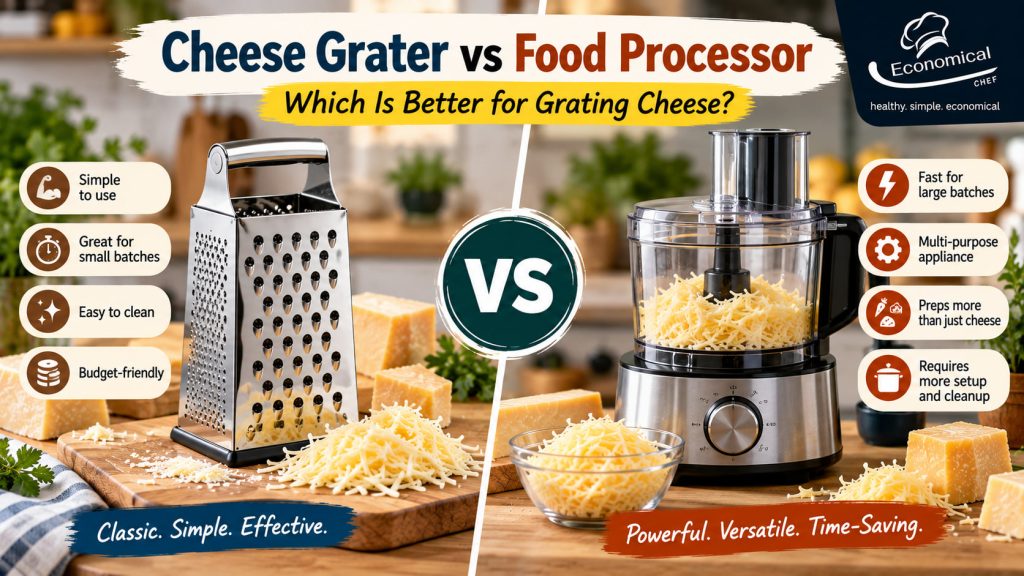
What Is a Cheese Grater?
A cheese grater is a kitchen tool specifically designed to shred, grate, or finely grate cheese using sharp cutting surfaces. Unlike a food processor, it’s dedicated to producing different cheese textures with minimal setup.
Common types include:
- Box graters for multiple shredding textures.
- Rotary graters for hard and semi-hard cheeses.
- Handheld graters for everyday shredding.
- Rasp-style graters for finely grating Parmesan or citrus zest.
Best Uses
- Parmesan and Pecorino.
- Cheddar and other semi-hard cheeses.
- Fresh cheese for pasta, pizza, soups, and salads.
- Small to medium quantities.
Chef’s Insight:
For everyday cooking, a cheese grater is often the fastest tool because it requires almost no setup or cleanup.
What Is a Food Processor?
A food processor is a motor-powered kitchen appliance that uses interchangeable blades and discs to chop, slice, shred, puree, and grate ingredients.
When fitted with a shredding disc, it can grate large quantities of cheese quickly and consistently.
Best Uses
- Bulk cheese shredding.
- Meal prep.
- Pizza and casserole ingredients.
- Shredding vegetables alongside cheese.
- Multi-purpose food preparation.
Chef’s Insight
A food processor isn’t just a cheese tool — it’s a prep appliance. If you’re already using it for vegetables or sauces, shredding cheese becomes an efficient extra step.
Cheese Grater vs Food Processor: Quick Comparison Table
|
Feature |
Cheese Grater |
Food Processor |
| Operation | Manual or hand-cranked | Electric motor |
| Speed | Excellent for small batches | Best for large batches |
| Effort | Low to moderate | Minimal manual effort |
| Texture Control | Excellent | Depends on shredding disc |
| Small Quantities | ⭐ Excellent | Good, but often unnecessary |
| Large Quantities | More work | ⭐ Excellent |
| Cleanup | Simple | More components to wash |
| Storage | Compact | Requires cabinet space |
| Best For | Everyday cheese grating | Meal prep & multi-purpose cooking |
What This Comparison Really Means
A cheese grater is a dedicated kitchen tool that’s ideal for everyday cooking and freshly grated cheese.
A food processor is a versatile appliance that becomes worthwhile when you’re preparing large quantities or multiple ingredients during the same cooking session.
Chef’s rule: Small jobs favor a cheese grater. Big prep sessions favor a food processor.
Key Differences Explained
1. Speed and Batch Size
A food processor clearly wins when you’re shredding multiple blocks of cheese.
If you’re preparing:
- Homemade pizza.
- Mac and cheese for a crowd.
- Meal prep.
- Party platters.
…the shredding disc processes cheese much faster than manual grating.
Chef’s Perspective
For one block of cheddar or Parmesan, a cheese grater is usually faster overall because there’s no assembly.
- Small dinner: Cheese grater.
- Bulk prep: Food processor.
2. Texture and Melt Quality
Texture matters more than many home cooks realize.
Different grating surfaces produce different shred sizes, which affect:
- Melting.
- Browning.
- Distribution.
- Mouthfeel.
Cheese Grater
- Fine Parmesan.
- Coarse cheddar.
- Thick mozzarella shreds.
- Multiple texture options with one tool.
Food Processor
- The texture depends entirely on the shredding disc installed.
Chef’s Perspective
If I’m making Alfredo or carbonara, I want finely grated Parmesan.
If I’m topping homemade pizza, I want larger mozzarella shreds.
A dedicated grater gives me better control.
3. Versatility Beyond Cheese
This is where the food processor separates itself.
Besides cheese, it can also prepare:
- Carrots.
- Potatoes.
- Cabbage.
- Cucumbers.
- Nuts.
- Herbs.
- Sauces.
- Dips.
Chef’s Perspective
If you’re buying one appliance to handle several prep jobs, a blender food processor combo provides much broader functionality. If your goal is simply fresh cheese, a grater is the more economical tool.
4. Cleanup and Kitchen Workflow
Cleanup often determines which tool chefs actually reach for.
Cheese Grater
- Wash one tool.
- Dry it.
- Store it.
Food Processor
You’ll usually clean:
- Bowl.
- Lid.
- Feed tube.
- Pusher.
- Shredding disc.
Chef’s Perspective: For weekday meals, quick cleanup often matters more than shaving 20 seconds off prep time.
5. Kitchen Space and Storage
A cheese grater takes very little storage space.
A food processor requires:
- Appliance base.
- Bowl.
- Lid.
- Multiple discs.
- Additional blades.
Chef’s Perspective: If you have a small apartment kitchen, drawer-friendly tools are often more practical.
6. Safety and Food Handling
Safety isn’t only about sharp blades — it’s also about handling cheese correctly.
Food Safety Tips
The U.S. Food and Drug Administration (FDA) recommends keeping cheese refrigerated at 40°F (4°C) or below and washing hands and utensils before handling cheese to reduce contamination risk.
The USDA also advises that:
- Hard cheeses such as Parmesan, Cheddar, Swiss, and Romano are generally safer than soft shredded cheeses when left unrefrigerated for short periods.
- Pre-shredded and freshly shredded cheeses should be refrigerated promptly after preparation.
Chef’s Perspective: Grate only the amount you’ll use immediately whenever possible. Freshly grated cheese has better flavor and reduces the amount of shredded cheese sitting exposed to air.
Cheese Grater vs Food Processor for Different Cheeses
Parmesan
Best Choice: Cheese grater.
Parmesan is a hard grating cheese traditionally grated into fine flakes or powder-like pieces.
A dedicated grater provides excellent texture for pasta and risotto.
Chef’s Tip: Use a rasp or fine rotary drum for the fluffiest Parmesan. Visit our Chef’s guide on What Is the Best Grater for Parmesan? for more.
Cheddar
Both tools work well.
Cheese Grater
- Burgers.
- Sandwiches.
- Salads.
- Tacos.
Food Processor
- Large casseroles.
- Mac and cheese.
- Nachos.
- Meal prep.
Mozzarella
Low-moisture mozzarella works well with both.
Chef’s Tip: Place mozzarella in the refrigerator for 20 – 30 minutes before shredding. Slightly chilled cheese holds its shape better and sticks less to blades.
Soft Cheeses
Very soft cheeses like fresh mozzarella, Brie, or cream cheese generally don’t shred well with either tool.
The FDA recommends extra care when handling soft cheeses because they support bacterial growth more easily than aged hard cheeses.
Pros and Cons Summary
Cheese Grater
Pros
- Excellent texture control.
- Simple and affordable.
- Easy to clean.
- Compact storage.
- Great for everyday cooking.
- No electricity required.
Cons
- More effort for large batches.
- Limited to grating and shredding.
- Can be slower when preparing large quantities.
Food Processor
Pros
- Fast for bulk cheese prep.
- Multi-purpose appliance.
- Minimal manual effort.
- Great for vegetables and meal prep.
- Consistent shredding for large quantities.
Cons
- Higher cost.
- Larger storage footprint.
- More parts to clean.
- Motor noise during use.
When a Cheese Grater Is Actually Better
A cheese grater isn’t simply the cheaper alternative—it can actually be the better kitchen tool.
Choose a cheese grater when you:
- Cook for one or two people.
- Grate cheese directly over food.
- Want multiple shred textures.
- Need only a small amount.
- Want fast cleanup.
- Have limited storage space.
Chef’s Recommendation: For most everyday meals, I’d grab a grater before plugging in a food processor.
When a Food Processor Is Worth It
A food processor becomes worthwhile when cheese is only one part of a larger prep session.
It’s ideal for:
- Weekly meal prep.
- Pizza parties.
- Large family meals.
- Shredding several blocks of cheese.
- Preparing vegetables at the same time.
Chef’s Recommendation: If you’re already slicing onions and shredding carrots, let the food processor handle the cheese too.
Food Quality: Freshly Grated vs Pre-Shredded Cheese
Freshly grated cheese often melts more smoothly than packaged shredded cheese.
Many packaged shredded cheeses contain anti-caking ingredients to help prevent clumping, while freshly grated cheese contains only the cheese itself. The FDA regulates grated cheese standards and ingredients used in commercially grated cheese products.
Chef’s Perspective: For creamy sauces, pizza, and baked pasta, freshly grated cheese almost always delivers a better texture.
How to Keep Cheese From Sticking to a Grater
One of the biggest frustrations is sticky cheese.
Chef Tips
- Chill cheese for 20–30 minutes before grating.
- Lightly oil the grater surface if using particularly sticky cheese.
- Grate firm cheese before it reaches room temperature.
- Clean the grater immediately after use.
For more stey-by-step guide, go to our Chef’s guide on How to Keep Cheese From Sticking to a Grater.
What Chefs Actually Use
In professional kitchens, both tools earn their place.
I Use a Cheese Grater For:
- Parmesan over pasta.
- Lemon zest.
- Garlic.
- Small blocks of cheddar.
- Garnishing soups and salads.
I Use a Food Processor For:
- Pizza cheese.
- Coleslaw.
- Potato gratin.
- Bulk vegetables.
- Meal prep.
Chef’s Takeaway: The goal isn’t owning the biggest appliance — it’s using the tool that creates the least work for the job.
Which One Should You Choose?
Choose a Cheese Grater If:
- You mostly grate cheese.
- You cook small or medium portions.
- You want quick cleanup.
- You have limited kitchen space.
- You want better control over shred size.
Choose a Food Processor If:
- You meal prep regularly.
- You cook for large families.
- You shred vegetables frequently.
- You want one appliance for many prep tasks.
- You already own or plan to buy a food processor.
Chef’s Final Conclusion
For everyday home cooking, I’d recommend a cheese grater.
It’s compact, inexpensive, easy to clean, and gives excellent control over cheese texture—especially for Parmesan, cheddar, and other hard cheeses.
For high-volume cooking and meal prep, a food processor is the better investment. It reduces manual effort and handles cheese alongside vegetables and many other ingredients.
FAQs
Can a food processor grate cheese?
Yes. Most food processors include a shredding or grating disc that can process hard and semi-hard cheeses.
Is freshly grated cheese healthier than pre-shredded cheese?
Freshly grated cheese usually contains only cheese, while packaged shredded cheese often includes anti-caking ingredients to keep the shreds separate.
Which tool is better for Parmesan?
A dedicated cheese grater is usually the better choice because it produces finer, fluffier Parmesan with better texture for pasta and sauces.
Is a food processor worth buying just for cheese?
Usually not. A food processor is worth buying if you’ll also use it for chopping, slicing, shredding vegetables, sauces, and meal prep.
How should freshly grated cheese be stored?
Store freshly grated cheese in a sealed container in the refrigerator at 40°F (4°C) or below, and use clean utensils when handling it.