Copper has been used for centuries as a material for storing and serving water, and modern research has investigated whether this traditional practice has a genuine antimicrobial effect. So, does copper water kill bacteria? The short answer is yes, copper can inactivate or kill certain bacteria under specific conditions. Laboratory studies have found that storing contaminated water in copper vessels can substantially reduce several bacterial pathogens, including E. coli, Salmonella, Shigella, and Vibrio cholerae. However, this does not mean that a copper bottle or dispenser can automatically make unsafe water safe to drink.
As a professional chef, I think the distinction is important. Copper can provide antimicrobial activity, but it should be considered an additional property of the material—not a replacement for safe drinking-water treatment, sanitation, or proper cleaning. In this guide, we’ll look at what the science actually shows, how copper affects bacteria, how long the process can take, and what you should know before relying on copper vessels for everyday water storage.
Does Copper Really Kill Bacteria?
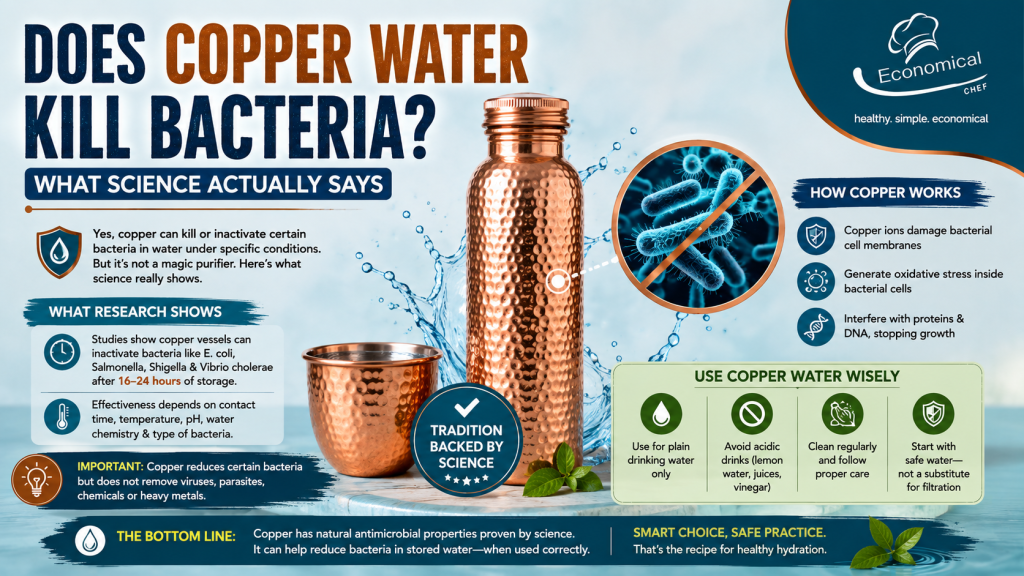
Yes. Research has demonstrated that copper can have strong antibacterial activity against a range of microorganisms.
One frequently cited study investigated water contaminated with several diarrheal disease-causing bacteria and stored it in copper pots for 16 hours at room temperature. The researchers found that they could no longer recover the tested Vibrio cholerae, Shigella flexneri, enterotoxigenic E. coli, enteropathogenic E. coli, Salmonella Typhi, and Salmonella Paratyphi from the copper-stored water. The study also measured copper in the water and found a concentration of approximately 177 micrograms per liter under its experimental conditions.
Another study examined E. coli in copper water-storage vessels and found that temperature and pH affected the speed of bacterial inactivation. The fastest inactivation occurred at higher temperature and at pH levels farther from neutral.
These results provide evidence that the antimicrobial properties of copper are not simply an ancient belief — they have been demonstrated experimentally.
How Does Copper Kill Bacteria?
Scientists generally attribute copper’s antimicrobial action to several damaging effects on microbial cells.
When bacteria come into contact with copper, copper ions can interact with the cell envelope and disrupt normal cellular processes. Copper can contribute to membrane damage and oxidative stress, while excessive copper inside the cell can interfere with proteins and genetic material.
Research on copper surfaces has found that copper can cause significant damage to bacterial cells. ACDC-hosted scientific review describes copper as an antimicrobial metal and discusses mechanisms including cell membrane damage, increased copper influx, and oxidative damage to cellular components.
However, the exact mechanism is complex and depends on the organism and surrounding conditions. It would therefore be too simplistic to say that copper instantly kills every bacterium it touches.
How Long Does Copper Take to Kill Bacteria?
This is one of the most important points for anyone considering a copper water bottle, copper dispenser, or copper pitcherfor personal and home use.
Copper’s antibacterial effect isn’t necessarily immediate. The amount of time required depends on the type and concentration of bacteria, water chemistry, temperature, copper surface condition, and other factors.
For example, research involving Salmonella Typhi, Salmonella Typhimurium, and Vibrio cholerae found that all three pathogens were inactivated after storage in a copper vessel for 24 hours. However, the researchers found evidence of substantially injured bacteria during shorter periods of 4–12 hours.
This is why I would avoid saying that simply putting water into a copper bottle for a few minutes makes it sterile. The evidence doesn’t support that claim.
Some studies have found significant bacterial reductions after several hours, but the exact timing isn’t universal.
Does Overnight Copper Water Kill Bacteria?
There is scientific evidence that extended storage in copper can reduce bacterial contamination.
The study involving six diarrheal pathogens found that no bacteria could be recovered after 16 hours of storage in copper pots under its experimental conditions.
Another study found complete inactivation of three important waterborne pathogens within 24 hours, while also showing that shorter storage periods could leave injured but potentially viable bacterial cells.
So, the traditional practice of storing water in a copper vessel overnight has some scientific basis when discussing bacterial reduction.
But there is an important qualification: overnight storage should not be interpreted as a guaranteed disinfection method for every type of contaminated water.
Does Copper Kill All Types of Bacteria?
No.
Copper has demonstrated antibacterial activity against multiple bacterial species, but laboratory results should not be interpreted as proof that a copper bottle eliminates every possible pathogen under every real-world condition.
The effectiveness can vary according to:
- Type of microorganism
- Initial microbial concentration
- Water temperature
- pH
- Dissolved minerals
- Organic matter
- Contact time
- Copper surface condition
- Whether the copper is bare or coated
For example, research on E. coli found that organic substances such as proteins, amino acids, humic acid, and complex organic mixtures could significantly slow bacterial inactivation in copper vessels. The researchers concluded that water composition can substantially influence both copper release and antibacterial effectiveness.
That is a good reminder that copper isn’t a one-size-fits-all water-treatment system.
Does Copper Kill Viruses and Parasites Too?
Copper has demonstrated antimicrobial activity against a broad range of microorganisms, but evidence for one organism or application shouldn’t automatically be generalized to every pathogen.
The U.S. Centers for Disease Control and Prevention (CDC) notes that copper and other metals can be used in certain environmental-control and disinfection applications, including copper-silver ionization for Legionella control. However, standard infection-control and disinfection practices remain necessary.
For drinking water specifically, the World Health Organization’s Guidelines for Drinking-water Quality emphasize managing drinking-water risks through comprehensive water-safety approaches rather than relying on a single storage material.
Therefore, I would not tell readers that storing water in copper automatically removes viruses, parasites, or other contaminants.
Does Copper Purify Drinking Water?
This requires careful wording.
Copper can reduce certain bacterial contaminants in water, but that is different from saying that a copper vessel is a complete water purification system.
If your source water is contaminated, the safest approach is to use an appropriate water-treatment method designed for the specific contamination risk. Copper storage can potentially provide additional antimicrobial activity, but it should not replace filtration, boiling, chemical disinfection, or another validated treatment method when those are needed.
The WHO’s guidance on household water management emphasizes that improving the microbiological quality of stored water requires appropriate household water treatment and safe storage practices.
From a chef’s perspective, I follow a simple rule: start with safe drinking water. A copper bottle or dispenser is a storage vessel, not a substitute for a reliable water-treatment system.
What Is the Oligodynamic Effect of Copper?
You may have seen the phrase oligodynamic effect used in articles about copper water.
It generally refers to the ability of very small amounts of certain metal ions to exert toxic effects on microorganisms. Copper ions are one reason copper surfaces and copper-containing materials can have antimicrobial properties.
However, the term shouldn’t be used as shorthand for “copper kills everything.” The antimicrobial effect depends on conditions such as contact time, copper availability, microorganism type, and water chemistry.
The scientific literature on copper water vessels demonstrates this clearly: different bacteria and different water compositions can produce different rates of inactivation.
Is Copper Water Safe to Drink?
Copper is an essential nutrient, but too much copper can be harmful.
The NIH Office of Dietary Supplements states that adults need about 900 micrograms of copper per day, while the adult tolerable upper intake level is 10,000 micrograms per day from all sources. Excessive copper exposure can cause nausea, vomiting, abdominal pain, diarrhea, and, with prolonged high exposure, liver damage.
The U.S. Environmental Progection Agency (EPA) currently lists 1.3 mg/L as the copper action level under its Lead and Copper Rule. Exceeding that level in more than 10% of sampled customer taps triggers additional treatment requirements for water systems.
The WHO also considers copper in its drinking-water quality guidance and provides a chemical fact sheet addressing its occurrence and health effects.
For that reason, I wouldn’t treat copper water as a source of extra copper that you need to maximize. The goal should be appropriate use and avoiding excessive exposure.
For a deeper look at the safety question, see our guide: Is Drinking Water from Copper Safe? What Science Says.
Does Pure Copper Work Better Than Copper-Plated Drinkware?
The answer depends on what you mean by “work.”
If you’re specifically interested in copper’s direct contact with water, a copper-plated or copper-colored exterior doesn’t necessarily provide the same exposure to copper as a vessel with a bare copper interior.
A bottle made from stainless steel with copper plating on the outside is still primarily a stainless steel container. The water may not directly contact the copper layer at all.
For readers comparing these materials, our guide Pure Copper vs Copper-Plated Water Bottles explains the differences in construction, maintenance, and intended use.
Does a Copper Bottle Need to Be Cleaned?
Absolutely.
Copper’s antimicrobial properties don’t mean that you can ignore basic hygiene.
The U.S. EPA’s protocol for antimicrobial copper-containing surfaces specifically states that routine cleaning is necessary and that antimicrobial copper surfaces do not replace standard hygiene or infection-control practices.
For a household copper water bottle or dispenser, I recommend:
- Emptying old water regularly
- Rinsing after use
- Hand washing according to the manufacturer’s instructions
- Drying the interior thoroughly
- Removing visible residue
- Avoiding abrasive cleaning methods
- Avoiding acidic beverages in unlined copper
A copper vessel can have antimicrobial properties while still becoming dirty. Those two facts aren’t contradictory.
For practical care instructions, see our guide on How to Use a Copper Water Bottle Properly.
Can You Put Lemon Water in a Copper Bottle?
For an unlined copper bottle, I recommend avoiding lemon water and other acidic beverages.
Lemon juice is acidic, and acidic liquids can increase the potential for copper to leach into the beverage. The FDA Food Code specifically restricts copper and copper alloys from contact with certain acidic foods and beverages because of this concern.
This is why I recommend keeping an unlined copper bottle for plain water and using glass or suitable stainless steel for lemon water, juice, and other acidic drinks.
We’ve covered this topic in more detail in Can You Put Lemon Water in a Copper Bottle? What You Should Know.
Can Copper Water Replace a Water Filter?
No.
A water filter and a copper vessel perform fundamentally different roles.
Depending on its technology and certification, a water filter may be designed to reduce specific contaminants such as particulate matter, certain chemicals, or microorganisms. Copper storage, by comparison, can provide antimicrobial activity against some bacteria under suitable conditions.
If your household water has a known contamination problem, use a treatment method appropriate for that contaminant rather than relying on copper storage alone.
The WHO’s drinking-water guidance emphasizes risk-based management and multiple barriers to protect drinking-water safety.
What Does the Science Actually Tell Us?
The evidence can be summarized in four points:
1. Copper has genuine antimicrobial properties
Laboratory research has repeatedly demonstrated that copper can inactivate bacteria.
2. Copper vessels can reduce certain bacterial pathogens in stored water
Studies involving E. coli, Salmonella, Shigella, and Vibrio cholerae have reported substantial or complete inactivation under controlled conditions.
3. The effect depends on conditions
Time, temperature, pH, water chemistry, organic matter, copper availability, and the microorganism itself can affect the result.
4. Copper storage is not a universal water purifier
It should not replace safe water sources, appropriate treatment, filtration, sanitation, or good storage practices.
Should You Store Drinking Water in Copper?
For someone who enjoys traditional copper drinkware, I think there is a reasonable place for it in the kitchen — provided it is used correctly.
If you’re starting with safe drinking water, a well-made copper bottle, pitcher, or dispenser can provide convenient storage and may offer antimicrobial activity against certain bacteria during prolonged contact. Research supports the basic antimicrobial effect, although the real-world performance will vary.
What I would avoid is treating copper as a cure-all. Don’t use it to justify drinking questionable water, don’t assume it eliminates every pathogen, and don’t deliberately increase copper exposure for supposed health benefits.
As a chef, I see copper water vessels primarily as functional drinkware with a scientifically recognized antimicrobial property, not as a replacement for proper water treatment.
Final Conclusion: Does Copper Water Kill Bacteria?
Yes, copper can kill or inactivate certain bacteria in water. Multiple laboratory studies have demonstrated that copper vessels can substantially reduce pathogens such as E. coli, Salmonella, Shigella, and Vibrio cholerae, particularly when water remains in contact with copper for several hours.
But the more accurate statement is that copper has antibacterial activity — it does not guarantee that every sample of copper-stored water is safe. The effectiveness depends on contact time, temperature, pH, water chemistry, the microorganism involved, and the condition of the copper vessel. Copper also needs to be used responsibly because excessive copper exposure can cause health problems. (ODS)
If you enjoy copper drinkware, use it as intended: start with safe drinking water, store plain water in a properly maintained vessel, avoid acidic beverages in unlined copper, and continue following normal water-safety and hygiene practices. That’s the most practical way to appreciate what copper can—and cannot—do.
References
- World Health Organization — Guidelines for Drinking-water Quality
Authoritative guidance on managing drinking-water quality and health risks.
WHO Guidelines for Drinking-water Quality - World Health Organization — Chemical Fact Sheet: Copper
Information on copper in drinking water, health effects, and drinking-water guidance.
WHO Chemical Fact Sheet: Copper - CDC — Miscellaneous Inactivating Agents
Discusses copper and other metals as antimicrobial agents and their use in environmental control and disinfection.
CDC: Miscellaneous Inactivating Agents - EPA — Antimicrobial Copper Surface Testing Protocol
Explains how antimicrobial claims for copper-containing surfaces are tested and emphasizes that copper surfaces do not replace standard hygiene practices.
EPA Copper Surface Testing Protocol - Sharan et al. — Inactivation of E. coli in Copper Water Storage Vessels
Peer-reviewed research examining how temperature and pH affect bacterial inactivation in copper vessels.
PubMed: E. coli in Copper Water Storage Vessel - Sharan et al. — Salmonella and Vibrio in Copper Water Storage Vessels
Peer-reviewed research examining the inactivation of Salmonella Typhi, Salmonella Typhimurium, and Vibrio cholerae.
BMC Infectious Diseases: Copper Water Storage Vessels - Sudha et al. — Storing Drinking-water in Copper Pots Kills Contaminating Diarrhoeagenic Bacteria
Study examining copper-pot storage and several diarrheal disease-causing bacteria.
PMC: Storing Drinking-water in Copper Pots - NIH Office of Dietary Supplements — Copper Fact Sheet
Evidence-based information about copper’s nutritional role, recommended intake, upper limits, and potential toxicity.
NIH Copper Fact Sheet