A copper water bottle can have an attractive, traditional appearance, but looks alone don’t tell you whether it’s actually made from pure copper. Some bottles are constructed from copper, while others use stainless steel or another base material with a thin copper coating or finish. If you’re shopping for an authentic copper bottle, understanding these differences can help you avoid confusing a copper-colored finish with genuine copper construction.
As a professional chef, I wouldn’t rely on internet tricks such as scratching the bottle, using a magnet, or judging the color alone. These methods can be misleading and may damage the product. Instead, I recommend checking the manufacturer’s material specifications, examining the interior construction, looking for clear information about copper composition and food-contact use, and asking the seller questions when important details are missing. Here’s my practical guide to how to tell if a copper water bottle is pure copper before you buy.
What Does “Pure Copper” Mean?
Before checking a bottle, it’s useful to understand what manufacturers mean by “pure copper.”
Commercial copper materials can contain very small amounts of other elements while still being classified as copper. ASTM International’s classification of copper includes materials with copper plus permitted elements, while recognized commercial grades such as C11000 contain approximately 99.90% copper.
For shoppers, however, the more practical question isn’t whether a bottle contains literally 100.000% copper.
It’s:
Is the bottle actually constructed from copper, or is copper simply being used as a coating or finish?
That’s the distinction I would focus on when buying.
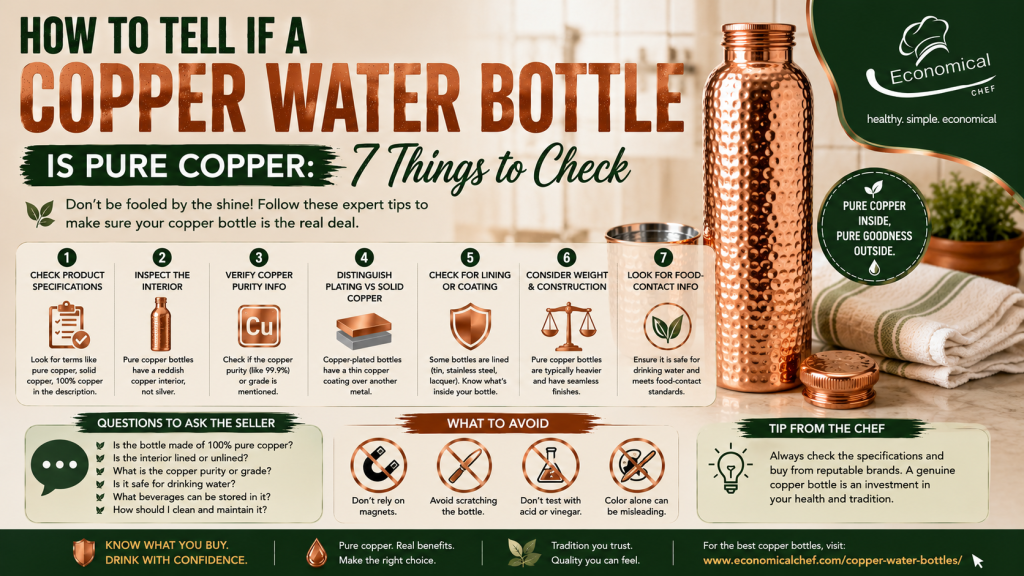
7 Things to Check Before Buying a Pure Copper Water Bottle
1. Check the Product Specifications
The first place to look is the manufacturer’s material specification.
Look for descriptions such as:
- Pure copper
- 100% copper
- Solid copper
- Copper construction
- Food-contact copper
- Unlined copper interior
Be more cautious with descriptions such as:
- Copper color
- Copper finish
- Copper coating
- Copper plated
- Copper-tone
- Copper look
These terms don’t necessarily mean that the bottle is made from solid copper.
When shopping, don’t rely exclusively on the product title. Check the Material field, product description, specifications, manufacturer’s information, and photographs.
From a chef’s perspective, I give considerably more weight to a clear material specification than to a marketing phrase such as “premium copper.”
2. Check the Interior, Not Just the Exterior
This is one of the most important checks.
A bottle can have a beautiful copper exterior while using a completely different material inside.
Look carefully at the product photographs and description for terms such as:
- Raw copper interior
- Unlined copper
- Stainless steel interior
- Food-grade lining
- Coated interior
- Tin-lined
If a bottle is described as copper-plated, another metal may form the underlying structure.
The material that comes into direct contact with your drinking water is particularly important.
The FDA Food Code places restrictions on copper and copper-alloy surfaces contacting certain acidic foods because copper can leach into food under those conditions.
So instead of asking only:
“Does this bottle look like copper?”
Ask:
“What material actually touches the water?”
That’s a much more useful buying question.
3. Don’t Confuse Copper-Plated With Solid Copper
A copper-plated bottle can look remarkably similar to a solid copper bottle, particularly when new.
For example, one bottle could have:
Stainless steel body → copper exterior coating
while another could have:
Copper body → copper interior
These are fundamentally different constructions.
If you want a deeper explanation of the difference, see our guide: Pure Copper vs Copper-Plated Water Bottles: What’s the Difference?
For shoppers, the important thing is to identify the base material and interior construction before buying.
4. Find Out Whether the Interior Is Lined or Unlined
Another important specification is whether the copper interior is bare or lined.
- Unlined copper: The drinking water comes directly into contact with the copper surface.
- Lined copper: Another material separates the water from the copper.
Neither description should automatically be considered better. What matters is whether the construction matches the manufacturer’s intended use.
If you specifically want traditional copper drinkware, an unlined interior may be important to you. However, you should also understand its beverage limitations.
For example, the FDA Food Code restricts copper and copper alloys from contact with foods below pH 6, including examples such as fruit juice, vinegar, and wine.
That’s why I recommend using an unlined copper bottle primarily for plain drinking water, rather than treating it as an all-purpose beverage container.
For more information, see our guide on Can You Put Lemon Water in a Copper Bottle?.
5. Look for Specific Information About Copper Purity
If a manufacturer says a bottle is made from pure copper, check whether it provides additional information about the material.
Useful details can include:
- Copper percentage
- Copper grade
- Material standard
- Manufacturing method
- Wall construction
- Interior material
- Food-contact information
A description such as “premium copper” doesn’t tell you much about actual composition.
For context, the Copper Development Association lists C11000 as a recognized wrought copper grade containing approximately 99.90% copper.
You don’t need to memorize copper grades to shop successfully. The practical lesson is simply:
Specific material information is more useful than vague marketing language.
6. Consider Weight and Construction — but Don’t Use Weight as Proof
A solid copper bottle may feel different from a thin plated bottle, particularly when it uses relatively thick copper or hand-hammered construction.
You can examine:
- Overall weight
- Wall thickness, if provided
- Hammered texture
- Seam construction
- Neck construction
- Base stability
- Cap construction
- Spout or opening
But there’s an important limitation:
Weight cannot prove copper purity.
A heavy stainless steel bottle can weigh more than a thin copper bottle. Likewise, a copper-plated bottle can have a substantial metal body underneath the coating.
So I would use weight and construction as supporting clues — not definitive evidence.
7. Check Food-Contact and Manufacturer Information
If you’re buying a bottle for drinking water, material composition isn’t the only consideration.
Look for information about:
- Intended beverage use
- Food-contact suitability
- Interior coating
- Cleaning instructions
- Acidic beverage restrictions
- Manufacturer identity
- Warranty
- Product documentation
The FDA explains that food-contact materials are evaluated according to their intended use and conditions of contact.
You may also encounter claims involving NSF certification. NSF/ANSI/CAN 61 addresses health effects associated with materials and components that contact drinking water, but don’t assume that a generic “NSF certified” statement applies to every part of a particular bottle. The certification should be traceable to the specific product or component.
Can You Tell If Copper Is Pure by Its Color?
Not reliably.
Copper has a distinctive reddish-orange appearance, but surface treatments can change the way it looks. Polishing, oxidation, lacquer, plating, and other finishes can all affect the color.
A copper-plated bottle can therefore look very convincing.
At the same time, genuine copper can become darker as it develops a natural patina.
So I wouldn’t use color as a standalone test.
Instead, use this order:
Material specification → interior construction → manufacturer information → intended use → supporting documentation
That’s a much more reliable buying process.
Can a Magnet Tell If a Copper Bottle Is Pure?
You may see advice online suggesting that you can use a magnet to determine whether a bottle is copper.
I wouldn’t consider this a definitive test.
Copper itself isn’t strongly attracted to an ordinary magnet, but a bottle may contain other materials in its cap, base, seams, or other components. A copper-plated bottle can also use a nonmagnetic base material.
More importantly, a magnet cannot tell you the percentage of copper in a material.
For a finished drinking bottle, manufacturer documentation is far more useful than a simple magnet test.
What About Scratching the Bottle?
I don’t recommend it.
Some online guides suggest scratching an inconspicuous area and examining the metal underneath to determine whether the bottle is plated.
Although this might reveal a different material in some cases, it isn’t a reliable consumer test and permanently damages the finish.
Scratching the interior is an even worse idea because it can damage the drinking surface.
If you’ve purchased an expensive handcrafted copper bottle, I wouldn’t risk damaging it simply to perform an informal test.
Is There a Reliable Home Test for Copper Purity?
Not one I would recommend as definitive.
You may encounter suggestions involving:
- Magnets
- Ice
- Scratching
- Sound
- Vinegar
- Salt
- Density
- Color comparison
These methods may sometimes provide clues, but they shouldn’t be presented as proof that a finished drinking bottle is pure copper.
Professional material analysis is a different matter. ASTM International publishes standardized methods for chemical analysis of copper materials.
Obviously, laboratory analysis isn’t practical for someone choosing a water bottle.
For everyday shopping, clear manufacturer specifications and documentation are the sensible first line of verification.
What Questions Should You Ask the Seller?
If the product listing doesn’t provide enough information, contact the manufacturer or seller.
Here are seven questions worth asking:
1. What is the exact base material?
Ask whether the entire bottle body is copper or whether another metal forms the underlying structure.
2. What percentage of copper does it contain?
If the seller claims “pure copper,” ask whether they can provide a specific purity specification or material grade.
3. Is the interior bare copper?
This is important if you’re specifically looking for an unlined copper vessel.
4. Is the interior lined or coated?
If yes, ask what material is used for the lining.
5. Is the bottle intended for drinking-water contact?
Don’t assume that every decorative copper vessel is designed for drinking.
6. What beverages can be stored inside?
This is particularly important if you plan to use the bottle for anything other than plain water.
7. How should it be cleaned?
A reputable manufacturer should be able to provide clear care instructions.
These questions are far more useful than simply asking, “Is this real copper?”
Does “Food-Grade Copper” Mean 100% Pure Copper?
No.
This is an important distinction.
“Food-grade” generally refers to suitability for a particular food-contact application. It isn’t necessarily a statement that the material contains 100.000% copper.
The FDA’s food-contact framework evaluates materials according to their intended conditions of use rather than treating “food-grade” as a universal purity designation.
Therefore, when evaluating a copper bottle, separate these two questions:
What is the bottle made from?
and
Is that construction appropriate for its intended food or drinking-water contact?
They’re related, but they’re not the same question.
Is a Pure Copper Water Bottle Better Than a Copper-Plated Bottle?
Not necessarily.
It depends on what you’re looking for.
A pure copper bottle may appeal to you if you want:
- Authentic copper construction
- Traditional craftsmanship
- Hand-hammered designs
- A natural copper patina
- Traditional drinkware
- A dedicated bottle for plain water
A copper-plated bottle may appeal to you if you want:
- The appearance of copper
- A different underlying material
- A modern manufactured design
- Different handling characteristics
- The properties of the underlying metal
The important thing is to know which construction you’re buying.
If a listing doesn’t clearly explain its materials, I’d choose another product with better documentation.
Does Pure Copper Provide Health Benefits?
This is an area where shoppers should be particularly cautious.
Copper is an essential nutrient. The NIH Office of Dietary Supplements states that adults need approximately 900 micrograms of copper per day, while the adult tolerable upper intake level is 10,000 micrograms per day from all sources. Excessive copper exposure can cause gastrointestinal symptoms and, at high chronic exposure, liver damage.
That doesn’t mean a pure copper bottle is inherently unhealthy. It means that more copper exposure isn’t automatically better.
I would therefore be skeptical of product claims suggesting that a copper bottle can cure disease, detoxify the body, dramatically boost immunity, or provide other medical benefits.
For a deeper look at the evidence, see our article: Is Drinking Water from Copper Safe? What Science Says
How to Choose an Authentic Copper Water Bottle
If I were choosing one for my own kitchen, I’d use this checklist.
✔ Check the material: Look for a clear statement identifying copper as the primary construction material.
✔ Check the interior: Determine whether it is bare copper, lined, or made from another metal.
✔ Check copper composition: Specific percentages or recognized material grades are more useful than vague descriptions such as “premium copper.”
✔ Check the manufacturer: Look for a manufacturer that provides clear specifications and care instructions.
✔ Check intended use: Make sure the product is intended for drinking water rather than decorative purposes.
✔ Check beverage restrictions: For unlined copper, plain water is the simplest choice. Don’t assume that the bottle is suitable for acidic beverages.
✔ Check cleaning instructions: A quality product should provide clear maintenance guidance.
Pure Copper Water Bottle Buying Checklist
Here’s a quick reference you can use while shopping online:
| What to Check | What You Want to See |
|---|---|
| Material | Pure/solid copper clearly specified |
| Copper composition | Specific percentage or grade when available |
| Interior | Clearly identified |
| Plating | No vague “copper finish” language |
| Food contact | Intended for drinking-water use |
| Manufacturer | Clear company and product information |
| Care | Detailed cleaning instructions |
| Claims | Specific and realistic rather than exaggerated |
If several of these details are missing, I’d keep looking.
What If the Product Listing Says “100% Copper”?
That’s a useful starting point, but I would still check the rest of the listing.
Look for consistency between:
- Product title
- Material specification
- Product description
- Interior photographs
- Manufacturer information
- Care instructions
If the title says “100% pure copper” but another section says “stainless steel interior,” the product deserves closer examination.
Likewise, a listing that says “copper finish” shouldn’t be interpreted as a solid copper product simply because the photographs show a copper-colored bottle.
Final Conclusion
The best way to determine whether a copper water bottle is genuinely made from copper is not through a viral home test. Start with the manufacturer’s material specification, then check the interior construction, copper composition information, intended food-contact use, and care instructions.
Remember that pure copper, copper-plated, copper-colored, and food-grade are not interchangeable terms. Recognized copper standards include commercial grades with very high copper content, while food-contact suitability is a separate consideration from material composition.
From a professional chef’s perspective, my advice is simple: buy the bottle with the clearest specifications, not the biggest health claims. If the manufacturer clearly identifies the material, explains the interior construction, provides sensible care instructions, and states that the vessel is intended for drinking water, you’re starting from a much stronger position.
If you’re ready to compare actual products, visit our guide to the Best Copper Water Bottles. You can also read Pure Copper vs Copper-Plated Water Bottles: What’s the Difference? before making your final decision.
References
- U.S. Food and Drug Administration — FDA Food Code 2022
Guidance concerning copper and copper-alloy surfaces and contact with acidic foods and beverages. - U.S. Food and Drug Administration — Food Types & Conditions of Use for Food Contact Substances
Explains how food-contact materials are evaluated according to food type and conditions of use. - NIH Office of Dietary Supplements — Copper Fact Sheet for Consumers
Provides information about copper’s nutritional role, recommended intake, upper limits, and potential health effects of excessive exposure. - NIH Office of Dietary Supplements — Copper Fact Sheet for Health Professionals
Provides detailed information about copper requirements, metabolism, and health effects. - ASTM International — Standard Classification of Coppers
Technical information concerning recognized commercial copper classifications. - Copper Development Association — Wrought Coppers
Information about recognized copper grades and their compositions. - NSF International — Official Product and Service Listings
Useful for checking specific certified drinking-water components and materials. - ASTM International — Chemical Analysis of Copper
Technical reference for standardized chemical analysis of copper materials.