Copper is widely used in kitchens for cookware, serving pieces, plumbing, and specialty equipment. But copper is not completely inert. When water or another liquid stays in contact with copper, a small amount of the metal can dissolve into the liquid. This process is known as copper leaching.
For home cooks and professional chefs, the important question isn’t simply “Does copper leach?” It does. The more useful question is when does copper leach more, and how should you use copper equipment accordingly?
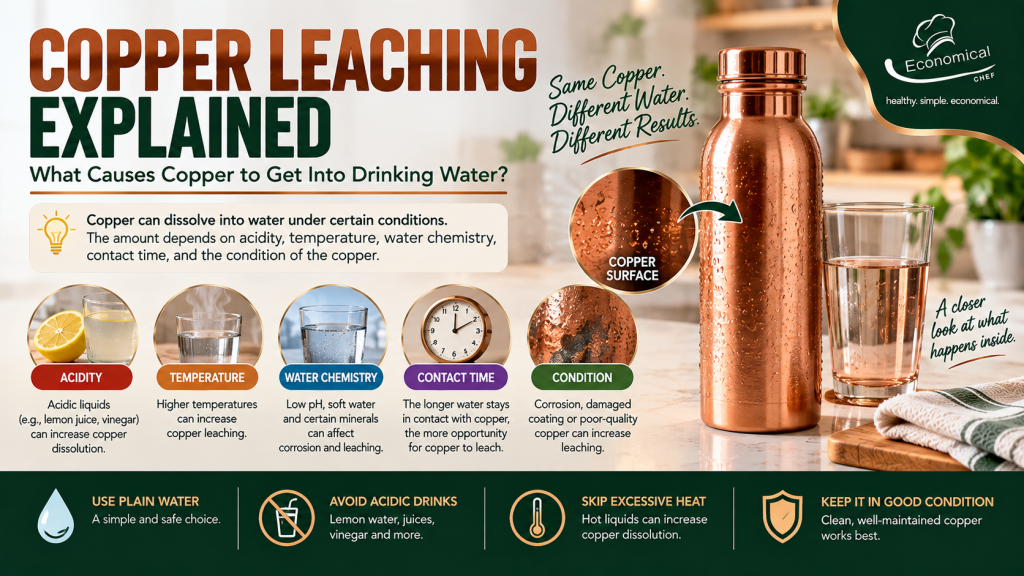
According to the National Academies, water chemistry, acidity, temperature, contact time, and the condition of the copper surface can all affect the amount released.
Chef’s quick rule: I treat bare copper as a specialty material, not an all-purpose container. For plain water and appropriate copper drinkware, it can be useful. For acidic foods and drinks, I reach for stainless steel, glass, or another suitable material.
What Is Copper Leaching?
Copper leaching is the movement of copper from a copper surface into the liquid touching it.
It can occur with:
- Copper water bottles
- Copper pitchers
- Copper water dispensers
- Copper cookware
- Copper plumbing
- Copper fittings
- Copper serving vessels
The amount of copper released isn’t fixed. It depends on the interaction between the copper, liquid, temperature, contact time, and water chemistry.
The National Academies also identifies increased acidity, higher temperature, reduced hardness, and stagnant water as conditions that can increase copper concentrations in water.
Leaching isn’t the same as tarnishing
This distinction is important.
Tarnishing is a visible change to the copper surface caused by chemical reactions with the environment.
Leaching means copper is actually entering the liquid.
So a darkened copper bottle isn’t automatically evidence that excessive copper has entered the water.
If you’re dealing with the appearance of tarnished copper, see our practical guide on How to Remove Tarnish From Copper.
What Makes Copper Leach More?
1. Acidic Liquids
This is the first thing I consider in a professional kitchen.
Acidic liquids can increase copper dissolution. The U.S. Food and Drug Administration (FDA Food Code) restricts copper and copper alloys from contact with foods with a pH below 6, including foods such as vinegar, fruit juice, and wine.
That makes a practical kitchen rule very easy:
Don’t use an unlined copper vessel as an all-purpose container for acidic liquids.
That includes:
- Lemon water
- Fruit juice
- Vinegar
- Wine
- Other strongly acidic beverages
This is why I wouldn’t store lemon water in an unlined copper bottle simply because lemon water is popular in wellness routines.
For the specific question, see Can You Put Lemon Water in a Copper Bottle?.
2. Higher Temperatures
Temperature can also influence copper corrosion and leaching.
The National Academies identifies increased temperature as one factor that can increase copper leaching from copper-containing plumbing.
My chef’s practice
I don’t treat an unlined copper bottle like a thermos.
For hot coffee, tea, broth, or other hot liquids, I’d use equipment specifically designed for those applications.
For everyday copper drinkware, plain cool or room-temperature water is the simplest use case.
3. Water Chemistry
The same copper vessel can behave differently with different water sources.
Factors such as:
- pH
- Hardness
- Dissolved minerals
- Temperature
- Dissolved gases
- Contact time
can influence copper dissolution.
The National Academies specifically identifies low pH, higher temperature, and reduced hardness as conditions associated with increased copper leaching.
Chef’s takeaway
I don’t assume that every water source will interact with copper in exactly the same way.
If you’re using a copper bottle at home, the safest practical approach is to avoid introducing additional variables — particularly acidic beverages and excessive heat.
4. Contact Time
The longer water remains in contact with copper, the longer the opportunity for copper-water interaction.
This is particularly relevant to the traditional practice of storing water in copper overnight.
However, “overnight” doesn’t mean that copper automatically becomes unsafe after a certain number of hours. Leaching depends on the entire set of conditions.
So I would not frame overnight storage as either automatically beneficial or automatically dangerous.
Instead, think of it as:
More contact time = more opportunity for copper to enter the water.
For the tradition and reasoning behind overnight storage, see Why People Store Water in Copper Overnight.
5. The Condition of the Copper
A chef also pays attention to the condition of the equipment.
I would be cautious with copper that has:
- Severe corrosion
- Pitting
- A damaged lining
- Peeling coating
- Unknown plating
- Cracks or damaged seams
- Heavy residue that can’t be removed properly
A copper vessel that’s structurally sound and intended for food or water contact is a very different situation from an old decorative copper object that happens to be used as a drinking container.
Don’t confuse “looks like copper” with “designed for food contact.”
That’s particularly important when buying inexpensive copper bottles, pitchers, and dispensers.
For that reason, our guide on How to Tell If a Copper Water Bottle Is Pure Copper focuses on construction, material, lining, and product claims.
What I Look for as a Chef Before Using Copper
When I’m evaluating copper equipment for kitchen use, I think about what the vessel will actually contact.
1. What am I putting in it?
Plain water is different from lemon juice, tomato sauce, wine, or vinegar.
2. How hot is it?
A vessel suitable for room-temperature water isn’t automatically suitable for hot liquids.
3. How long will it sit?
A serving vessel and a container designed for prolonged storage aren’t necessarily used the same way.
4. Is the interior bare copper?
If the interior is lined, I want to know what the lining is and what the manufacturer says it’s designed for.
5. Is the surface intact?
I don’t use food-contact equipment with a damaged interior simply because the exterior still looks attractive.
6. Is it actually food-contact equipment?
Decorative copper and kitchen-grade copper should not automatically be treated as interchangeable.
That’s a much more useful approach than simply asking whether something is “100% copper.”
Copper Leaching in the Professional Kitchen
Copper has legitimate culinary applications.
For example, chefs have long valued copper cookware because of its excellent heat conductivity and responsiveness. Copper is also used in specialized culinary processes where its properties are useful.
But professional kitchens don’t generally treat every copper item as suitable for every ingredient.
The ingredient determines the appropriate equipment.
For acidic foods, a chef may choose stainless steel, glass, enamel, or another suitable food-contact surface rather than bare copper.
The FDA Food Code reflects this same principle by restricting copper and copper alloys from contact with acidic foods below pH 6, with specific exceptions for certain brewing operations.
That’s the practical lesson: Copper is a specialized kitchen material — not a universal one.
Copper Bottle: What Would a Chef Actually Put in It?
For an unlined copper water bottle, my simple hierarchy would be:
Best choice
Plain drinking water
This is the straightforward use case for a copper water vessel.
Use caution
Water stored for an extended period
Contact time becomes another variable, so follow the product’s intended-use instructions.
Avoid
Lemon water and acidic beverages
Acidic liquids can increase copper dissolution, and the FDA Food Code specifically restricts copper contact with acidic foods below pH 6.
Choose another vessel
Hot drinks, juices, wine, vinegar-based drinks, or other specialized beverages
As a chef, I would simply use equipment designed for those applications rather than trying to make copper do everything.
Does Copper Leaching Mean Copper Bottles Are Unsafe?
Not automatically.
Copper is an essential mineral, but excessive exposure can cause adverse health effects. The National Academies notes that excessive copper ingestion can cause acute gastrointestinal effects and that chronic exposure can be associated with liver toxicity in susceptible people.
The important point is that the amount of copper matters.
A copper vessel doesn’t suddenly make every liquid unsafe. The amount that enters the liquid depends on the conditions.
That’s why I prefer a practical approach over either extreme:
Don’t panic about copper — but don’t treat it as chemically inert, either.
For the broader question of drinking water from copper, see our dedicated article Is Drinking Water From Copper Safe? What Science Says.
How to Reduce Copper Leaching: The Chef’s Checklist
If you’re using a copper bottle, pitcher, or dispenser, keep these habits simple:
✔ Use plain water
Especially with unlined copper drinkware.
✔ Avoid acidic beverages
Don’t use an unlined copper vessel to store lemon water, juice, vinegar-based drinks, or wine.
✔ Avoid unnecessary heat
Use vessels specifically designed for hot liquids.
✔ Don’t leave questionable liquids sitting in copper
The longer the contact time, the greater the opportunity for interaction.
✔ Inspect the interior
Don’t ignore damaged coatings, severe corrosion, pitting, or unknown materials.
✔ Follow manufacturer instructions
This is especially important for lined or plated products.
✔ Choose the right material for the job
In my kitchen, stainless steel and glass are the default when I need a versatile container. Copper has specific advantages, but it doesn’t need to replace every other material.
My Chef’s Rule for Copper
After working with different kitchen materials, I find the simplest rule is the most useful:
Choose the vessel based on what you’re putting in it — not simply on what the vessel is made from.
Copper is excellent when its properties are useful. But if I’m storing lemon juice, tomato-based food, wine, vinegar, or another acidic product, I don’t reach for bare copper.
If I’m storing plain drinking water in an appropriate copper vessel, that’s a much more straightforward application.
The same principle applies to professional kitchens: good equipment use is about matching the material to the food, temperature, and storage conditions.
Bottom Line
Copper leaching is a normal chemical interaction that can increase under certain conditions — particularly higher acidity, higher temperature, reduced water hardness, and prolonged contact.
From a chef’s perspective, there’s no need to fear copper, but there’s also no reason to use it indiscriminately. Use copper where it makes culinary sense, use plain water in unlined copper drinkware, avoid acidic beverages, pay attention to the condition of the vessel, and choose stainless steel or glass when you need a more versatile container.
References
- U.S. Food and Drug Administration (FDA). 2022 Food Code. The FDA Food Code explains that copper and copper-alloy surfaces can leach copper when they contact acidic foods and beverages and provides restrictions on copper contact with acidic foods.
- U.S. Environmental Protection Agency (EPA). National Primary Drinking Water Regulations. The EPA lists a copper action level of 1.3 mg/L and identifies corrosion of household plumbing as a major source of copper in drinking water.
- World Health Organization (WHO). Chemical Fact Sheets: Copper. This fact sheet summarizes WHO’s assessment of copper in drinking water, including its health effects and drinking-water guideline information.
- World Health Organization (WHO). Guidelines for Drinking-water Quality: Fourth Edition Incorporating the First, Second and Third Addenda. This is the latest WHO edition of its drinking-water quality guidelines and provides the broader framework for managing chemical risks in drinking water.
- National Academies of Sciences, Engineering, and Medicine. Copper in Drinking Water. This reference discusses copper corrosion and factors affecting copper concentrations in drinking water, including pH, temperature, water hardness, and stagnation.
1 thought on “Copper Leaching Explained: What Causes Copper to Get Into Drinking Water?”