A cheese grater is one of the most useful tools in the kitchen, but it can also be one of the most frustrating to clean. Melted cheese, fine Parmesan particles, and oily residue can become trapped inside the tiny grating holes, especially if you leave the grater sitting after cooking.
The good news is that cleaning a cheese grater doesn’t have to be difficult. Whether you’re using a box grater, rotary grater, handheld rasp, or electric cheese grater, the key is to remove the cheese before it dries, use a suitable brush, and handle sharp grating surfaces carefully.
From a chef’s perspective, the best routine is simple: remove the excess cheese, wash with warm soapy water, brush away stubborn residue, rinse thoroughly, and dry completely.

Why Is a Cheese Grater So Difficult to Clean?
Cheese graters have dozens of sharp perforations designed to cut through food. Unfortunately, those same holes can trap small pieces of cheese.
Soft cheeses such as mozzarella and cheddar can leave sticky residue, while hard cheeses such as Parmesan can leave fine particles throughout the grating surface.
Once cheese dries, it becomes much harder to remove.
That’s why I recommend cleaning your grater as soon as you’re finished using it rather than leaving it beside the sink until later.
From a food-safety perspective, keeping utensils clean is important because food residue can contribute to contamination and transfer between foods. The U.S. Food and Drug Administration (FDA) also recommends washing utensils and food-contact surfaces with hot, soapy water after preparing food.
How to Clean a Cheese Grater Step by Step
1. Remove Loose Cheese First
Before adding water, remove as much loose cheese as possible.
- For a box or handheld grater, gently shake or tap it over a bowl, plate, or trash can.
- For a rotary grater, remove the drum if the manufacturer’s instructions allow it and clear away loose cheese.
- For an electric grater, unplug the appliance first before removing any detachable parts.
Don’t use your fingers to pull cheese from sharp grating holes. Even a small box grater can cause a cut if handled carelessly.
2. Rinse With Warm Water
Once the loose cheese is removed, rinse the grater under warm running water.
Warm water can help loosen oily cheese residue before you start scrubbing.
If cheese has already dried, allow the grater to sit in warm, soapy water for a short period if the manufacturer’s care instructions permit soaking.
Avoid prolonged soaking if the grater contains:
- Wooden handles
- Carbon steel
- Electrical components
- Mechanical parts
- Special coatings
Chef’s tip: If you clean the grater immediately after use, you usually won’t need much soaking at all.
3. Add Dish Soap
Apply a small amount of regular dish soap to a soft dish brush or suitable cleaning brush.
Work carefully over each grating surface.
For a box grater, remember that cheese can remain on several sides — not just the surface you used.
For a fine rasp-style grater, avoid aggressively rubbing a sponge across the sharp teeth. A soft brush is generally easier to control.
4. Brush Away Trapped Cheese
A small cleaning brush is particularly useful for cheese stuck inside the perforations.
Brush gently across the grating surface until the remaining particles are released.
For stubborn residue, approach the surface from the back side when practical, rather than pressing your fingers or a sponge directly against the sharp cutting edges.
As experienced chef, I specifically advise keeping your fingers away from box-grater blades and stopping when the food becomes too small to hold safely.
5. Rinse Thoroughly
After scrubbing, rinse the grater thoroughly under running water.
Pay particular attention to:
- Fine grating holes
- The underside of perforations
- Corners and seams
- Rotary drums
- Detachable components
- Areas around handles
You want to remove both food residue and dish soap before drying.
6. Dry Completely
Drying is the final step that many people overlook.
Shake off excess water, then either:
- Air-dry the grater completely, or
- Carefully dry it with a clean towel.
Make sure the grater is completely dry before putting it into a drawer or cabinet.
This is particularly important for metal graters because prolonged moisture can contribute to corrosion or rust depending on the material.
How to Clean a Box Grater Specifically

A box grater is relatively straightforward to clean because all of its grating surfaces are exposed.
My preferred method:
- Remove loose cheese.
- Rinse with warm water.
- Apply dish soap.
- Scrub each side with a soft brush.
- Pay special attention to fine holes.
- Rinse thoroughly.
- Inspect for trapped cheese.
- Dry completely.
Don’t forget the inside of the box. Cheese particles can collect around the back of the perforations.
Chef’s tip: Hold the box grater by its handle or another safe area rather than placing your fingers close to the cutting surfaces.
How to Clean a Rotary Cheese Grater Specifically

Rotary graters need a little more attention because cheese can become trapped inside the rotating drum.
Follow these steps:
- Remove the drum according to the manufacturer’s instructions.
- Shake out loose cheese.
- Rinse the drum.
- Wash with warm soapy water if permitted.
- Use a small brush to clean the perforations.
- Clean the handle and housing separately.
- Rinse thoroughly.
- Dry completely before reassembly.
Never force a drum out of a rotary grater if it isn’t designed to be removed.
If the rotary grater has several detachable parts, check the manufacturer’s cleaning instructions before placing any component in a dishwasher.
How to Clean a Fine Rasp or Microplane-Style Grater Specifically
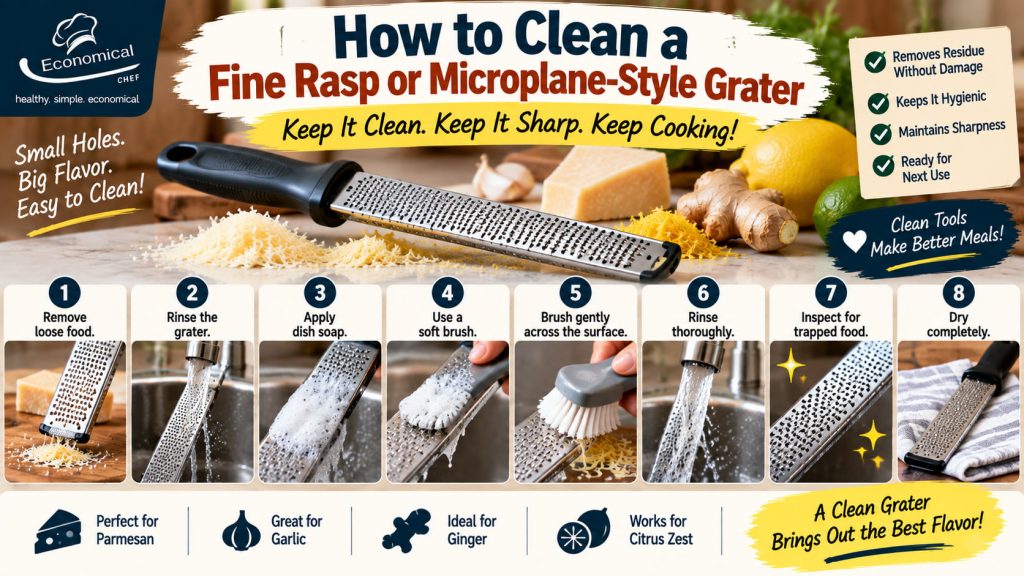
Fine rasp graters are excellent for Parmesan, garlic, ginger, and citrus zest, but their small cutting teeth can make cleaning tricky.
The safest approach is:
- Remove loose food first.
- Rinse the grater.
- Apply dish soap.
- Use a soft brush.
- Brush gently across the surface.
- Rinse thoroughly.
- Inspect for trapped food.
- Dry completely.
Avoid dragging your fingers across the grating surface.
If a sponge repeatedly catches on the teeth, switch to a brush.
How to Clean an Electric Cheese Grater

Electric cheese graters need a slightly different cleaning routine.
The most important rule is simple:
Unplug the appliance before cleaning.
Never clean an electric grater while it is connected to power.
Then separate the parts that the manufacturer identifies as removable.
For removable food-contact parts:
- Unplug the machine.
- Remove the grating drum, blade, chute, or other detachable components.
- Remove loose cheese.
- Wash compatible parts with warm soapy water.
- Use a small brush to clean holes and crevices.
- Rinse thoroughly.
- Dry completely.
- Wipe the motor housing with a damp cloth.
- Reassemble only when all parts are dry.
Never immerse the motor housing
The electrical base or motor housing should not be submerged in water unless the manufacturer specifically designs it for that purpose.
Instead, wipe the exterior with a damp cloth and follow the manufacturer’s cleaning instructions.
What about the dishwasher?
Some electric graters have dishwasher-safe removable components, while others don’t.
Never assume that a detachable part is dishwasher-safe simply because it comes off the machine.
Check the manufacturer’s instructions for the specific model.
Chef’s tip: Electric graters can have more crevices than manual graters, so don’t rush the cleaning step. Inspect around the drum, chute, blade assembly, and other areas where cheese can accumulate.
How to Remove Dried Cheese From a Grater
If you’ve forgotten to clean the grater and the cheese has hardened, don’t try to scrape it aggressively with a knife.
Instead:
- Remove any loose pieces.
- Soak the grater briefly in warm soapy water if appropriate for its materials.
- Use a soft cleaning brush.
- Work gently around the clogged holes.
- Rinse.
- Repeat if necessary.
For electric graters, only soak removable components that the manufacturer says can safely be immersed.
Don’t use your fingers to dig hardened cheese out of individual holes.
Patience is safer than aggressive scraping.
Brush vs. Sponge: Which Is Better?
For most cheese graters, I prefer a soft dish brush.
| Cleaning Tool | Best Use | Chef’s Recommendation |
|---|---|---|
| Soft dish brush | Box and rotary graters | Excellent all-around choice |
| Small cleaning brush | Fine holes and crevices | Excellent for stubborn residue |
| Soft sponge | Smooth surfaces | Useful but can catch on sharp teeth |
| Paper towel | Removing loose cheese | Good for quick cleanup |
| Metal scrubber | Heavy-duty residue | Usually unnecessary |
A brush can reach inside grating holes without requiring you to place your fingers directly against the sharp surface.
Can You Put a Cheese Grater in the Dishwasher?
Only if the manufacturer says it is dishwasher-safe.
Some stainless-steel graters can be cleaned in an integrated or tabletop dishwasher, while others have components that are better suited to hand washing.
This is especially important with:
- Electric graters
- Rotary graters
- Graters with wooden handles
- Coated surfaces
- Plastic components
- Multi-part grating systems
When in doubt, check the manufacturer’s care instructions.
From a chef’s perspective, hand washing also gives you an opportunity to inspect the grating holes and make sure no cheese remains trapped.
How to Clean Cheese From a Rotary Drum
Rotary drums deserve special attention because cheese can become trapped both on the outside and inside.
After removing the drum:
- Shake out loose cheese.
- Rinse thoroughly.
- Brush the perforations.
- Check the inside of the drum.
- Wash with soapy water if permitted.
- Rinse again.
- Allow it to dry completely.
Don’t use your fingers to push cheese through the grating holes.
How to Clean Cheese From a Fine Grater
For Parmesan or other hard cheeses, fine graters can collect tiny particles across the entire surface.
After use, gently tap the grater to remove loose particles.
Then:
Rinse → Soap → Brush → Rinse → Dry
If the cheese is already dry, brief soaking can help loosen it when the grater’s materials allow it.
A fine rasp is one of the reasons I recommend cleaning a grater immediately after use. Once Parmesan particles become lodged between the tiny teeth, cleaning takes considerably more effort.
For more information about choosing a Parmesan grater, see our Chef’s Guide on What Is the Best Grater for Parmesan?.
Do You Need to Sanitize a Cheese Grater?
For normal household use, proper washing is the starting point.
Cleaning removes food residue and other soils. Sanitizing is a separate process intended to reduce microorganisms after cleaning. The U.S. Food and Drug Administration (FDA Food Code) treats cleaning and sanitizing as distinct steps.
For an ordinary cheese grater used for cheese, washing it thoroughly with dish soap and water after use is the practical routine.
Additional sanitizing may be appropriate in situations involving potentially contaminated food or specific food-safety concerns. In those cases, use an appropriate food-contact sanitizer and follow its label directions rather than improvising a concentration.
The FDA’s current food-safety guidance emphasizes the basic sequence of keeping food-contact utensils and surfaces clean and using appropriate sanitation procedures when necessary.
How to Keep Your Cheese Grater Cleaner
The easiest grater to clean is the one you don’t allow to become heavily coated with dried cheese.
Here are a few habits I use in the kitchen:
- Clean it immediately: Don’t leave the grater beside the sink for hours.
- Remove loose cheese first: Shaking or brushing away loose particles makes washing easier.
- Don’t overload a rotary grater: Large amounts of cheese can accumulate inside the drum.
- Use the correct grater: Using an appropriate grating surface can reduce excessive buildup.
- Don’t press too aggressively: Controlled pressure is usually enough to grate cheese effectively.
- Dry after washing: Don’t put a wet metal grater directly into storage.
How to Prevent Cheese From Sticking to a Grater
Cleaning becomes easier when you reduce the amount of cheese left behind.
A few practical techniques include:
- Choose the right grater for the cheese.
- Keep cheese appropriately chilled when this helps with handling.
- Use controlled pressure.
- Avoid forcing too much cheese through a rotary drum.
- Remove remaining cheese immediately after grating.
- Wash the grater before residue dries.
For Parmesan, a fine rasp can create a light, fine texture, while a rotary grater can be useful when you’re preparing a larger quantity.
For more techniques, see How Our Chef Prevent Cheese From Sticking to a Grater.
How Often Should You Clean a Cheese Grater?
Every time you use it.
A cheese grater is a food-contact utensil, so it should be washed after each use.
FDA consumer guidance recommends washing utensils and food-contact surfaces with hot, soapy water after preparing food.
This doesn’t mean cleaning has to become a time-consuming chore.
In most kitchens, a quick wash immediately after grating is enough to prevent cheese from drying inside the holes.
Common Cheese Grater Cleaning Mistakes
- Waiting until the cheese dries: This is probably the most common mistake. Fresh residue is much easier to remove than hardened cheese.
- Cleaning with your fingers: Grating surfaces are sharp. Keep your fingers away from the cutting edges.
- Using a knife to dig out cheese: A knife can damage the grater and creates another sharp edge to handle.4
- Using an overly aggressive scrubber: You usually don’t need a metal scouring pad to clean a cheese grater.
- Forgetting the inside of a rotary drum: Cheese can collect inside as well as outside.
- Submerging an electric motor: Never immerse the electrical housing unless the manufacturer specifically states that it is designed for immersion.
- Assuming every removable part is dishwasher-safe: Always check the manufacturer’s instructions.
- Storing the grater while wet: Allow it to dry completely before putting it away.
Chef’s Cleaning Routine for Every Type of Cheese Grater
If I’m working in a busy kitchen, I keep the process simple:
Remove → Rinse → Soap → Brush → Rinse → Dry
For an electric grater, add one important step at the beginning:
Unplug → Remove parts → Rinse → Soap → Brush → Rinse → Dry → Reassemble
The biggest time-saving habit is cleaning the grater before cheese has a chance to dry.
Frequently Asked Questions
Can I soak a cheese grater overnight?
It’s better to avoid overnight soaking unless the manufacturer specifically permits it. Prolonged exposure to water may not be suitable for certain metals, coatings, wooden handles, or mechanical components.
What is the easiest way to clean a cheese grater?
Clean it immediately after use with warm soapy water and a soft brush. This is usually much easier than removing dried cheese later.
How do you clean an electric cheese grater?
Unplug it first, then remove the food-contact components according to the manufacturer’s instructions. Wash compatible removable parts with warm soapy water, clean the motor housing with a damp cloth, and allow everything to dry completely before reassembly.
Can I put my cheese grater in the dishwasher?
Only if the manufacturer says it is dishwasher-safe. This is particularly important for electric and rotary graters with multiple components.
How do you remove dried cheese from a grater?
Briefly soak the grater in warm soapy water if its materials allow it, then use a soft brush to loosen the cheese. Avoid knives and your fingers.
Final Thoughts
Cleaning a cheese grater is much easier when you do it immediately after cooking. Remove loose cheese, wash with warm soapy water, use a soft brush for stubborn residue, rinse thoroughly, and dry completely.
For box, rotary, and fine rasp graters, the biggest concern is handling the sharp grating surfaces safely. For electric cheese graters, the additional rule is simple: unplug the appliance and keep the motor housing away from water.
From a chef’s perspective, you don’t need an elaborate cleaning routine. A few minutes of proper cleanup after each use will keep your grater ready for the next batch of Parmesan, cheddar, vegetables, or other ingredients.
Reliable References
- U.S. Food and Drug Administration (FDA) — Cleaning: Food Safety for Moms-to-Be: Guidance on washing utensils and food-contact surfaces with hot, soapy water. ()
- U.S. Food and Drug Administration (FDA) — Food Code: Technical guidance distinguishing cleaning from sanitizing food-contact surfaces and utensils.
- University of Illinois Extension — How to Safely Use Cutting Tools: Practical guidance for safely using box graters and keeping fingers away from the blades.