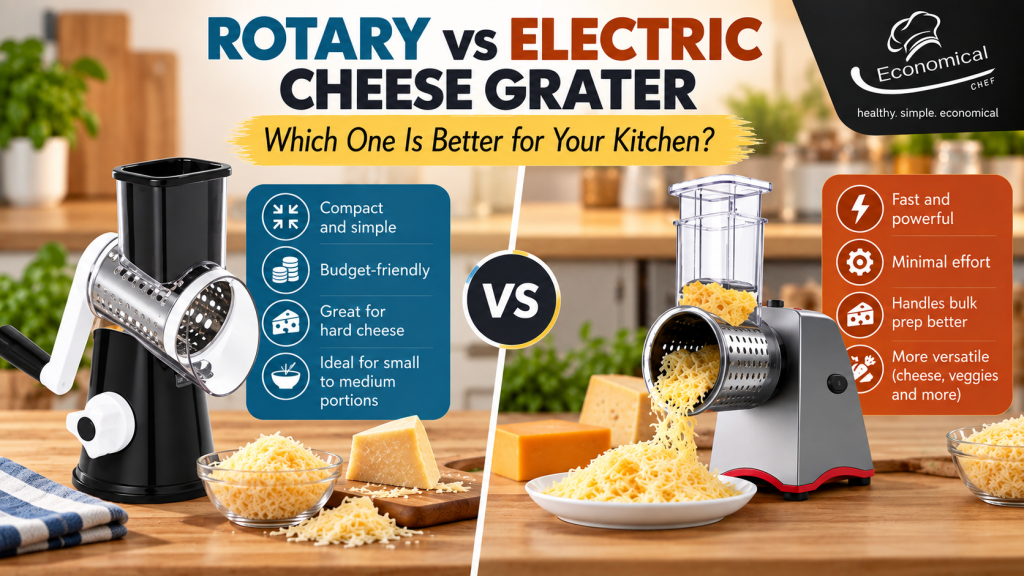
If you regularly grate cheese for pasta, pizza, casseroles, salads, or meal prep, choosing between a rotary and electric cheese grater can make a surprising difference in your kitchen.
A rotary grater gives you manual control, compact storage, and excellent performance with hard and semi-hard cheeses, while an electric grater is designed for speed, reduced hand effort, and larger batches.
So which one is better?
For most home cooks, a rotary grater is the more practical choice. But if you grate large quantities frequently, an electric model can save significant time and effort.
What Is a Rotary Cheese Grater?
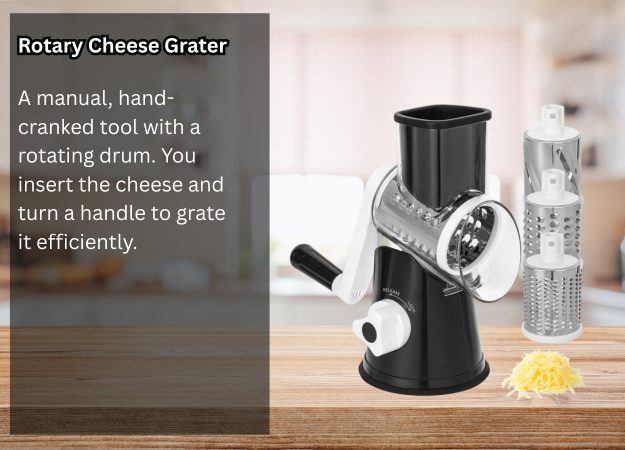
A rotary cheese grater is a manual, hand-cranked tool with a rotating drum. You insert the cheese and turn a handle to grate it efficiently.
Best for:
- Parmesan, Pecorino and other hard cheeses
- Cheddar, Swiss and other semi-hard cheeses
- Grating directly over pasta and salads
- Small to medium quantities
- Cooks who prefer a controlled manual tool
Looking for a manual model? Check out our guide to the best rotary cheese graters.
What Is an Electric Cheese Grater?
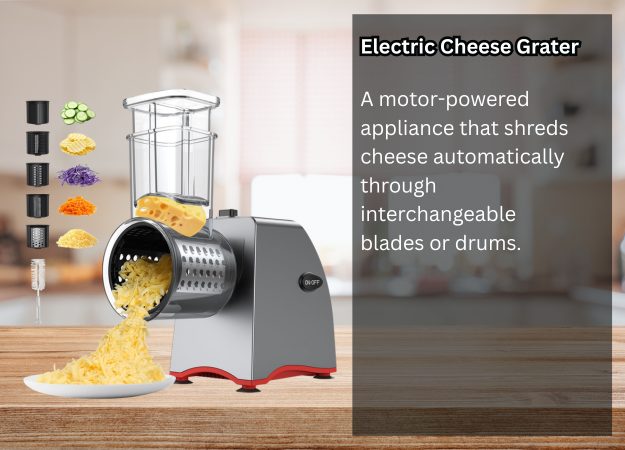
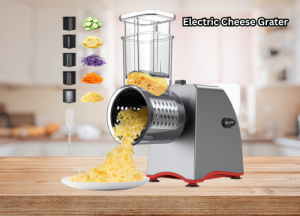
An electric cheese grater is a motor-powered appliance that shreds cheese automatically through interchangeable blades or drums.
Best for:
- Bulk prep
- Multiple ingredients (cheese, vegetables, nuts)
- Fast, consistent output
Prefer an electric option? See our picks for the best electric cheese graters.
Rotary vs Electric Cheese Grater: Quick Comparison Table
Here’s a clear side-by-side breakdown to help you decide quickly:
| Feature | Rotary Cheese Grater
|
Electric Cheese Grater
|
|---|---|---|
| Operation | Hand-cranked | Motor-powered |
| Effort | Low to moderate | Very low |
| Speed | Fast for small batches | Best for larger batches |
| Best For | Cheese and everyday prep | High-volume cheese & vegetable prep |
| Cheese Types | Excellent with hard & semi-hard cheese | Handles many cheese types depending on model |
| Versatility | Moderate | High |
| Consistency | Very good | Very consistent |
| Safety | Enclosed drum | Feed chute/pusher recommended |
| Noise | Very quiet | Motor noise |
| Cleaning | Usually simpler | More components |
| Storage | Compact | Larger footprint |
| Electricity | Not required | Required |
| Price | Usually lower | Usually higher |
| Best For | Most home cooks | Frequent or high-volume prep |
What This Comparison Really Means (Chef’s Insight)
Tables above are helpful — but here’s how it plays out in a real kitchen:
- Rotary graters are about control and convenience. You grab it, grate fresh cheese over your pasta, rinse it, and you’re done.
- Electric graters are about efficiency and output. When you’re prepping multiple dishes or cooking for a family, the time saved is significant.
👉 Think of it this way:
- Rotary = precision tool
- Electric = prep machine
Key Differences Explained
1. Effort & Ease of Use
- Rotary: Requires a simple hand motion
- Electric: Fully automated
👉 If you cook occasionally, rotary feels natural. If you cook daily, electric reduces fatigue.
2. Speed & Volume
- Rotary: Great for quick meals
- Electric: Built for bulk prep
👉 Grating cheese for one pasta dish? Rotary is perfect.
👉 Prepping for pizza night or meal prep? Electric saves time.
3. Versatility
- Rotary: Limited to harder ingredients
- Electric: Handles cheese, vegetables, and more
👉Many electric graters can do more than cheese, with interchangeable discs for shredding and slicing vegetables and other ingredients.
4. Cleaning & Maintenance
- Rotary: Faster cleanup
- Electric: More parts but often dishwasher-safe
👉 If you hate cleanup, rotary wins.
5. Kitchen Space
- Rotary: Fits in any drawer
- Electric: Needs storage space or counter space
👉 Small kitchen = rotary is the practical choice.
6. Noise & Kitchen Experience
- Rotary: Quiet. You’re doing the work manually, so there’s no motor noise.
- Electric: Motor noise can be noticeable, particularly with higher-powered models.
For someone who only needs to grate a little Parmesan over pasta, an electric motor can actually feel like overkill.
Pros and Cons Summary
Rotary Cheese Grater
Pros
- Affordable
- Compact
- Safe and simple
- Ideal for table-side use
Cons
- Slower for large batches
- Not suitable for soft cheese
- Limited functionality
Electric Cheese Grater
Pros
- Fast and powerful
- Minimal effort
- Multi-purpose use
- Consistent results
Cons
- More expensive
- Bulkier
- Requires cleaning more parts
Which One Should You Choose?
Choose a Rotary Grater if:
- You cook small portions
- You mainly use hard cheeses
- You want a simple, budget-friendly tool
- You have limited kitchen space
Choose an Electric Grater if:
- You cook frequently or in bulk
- You want versatility beyond cheese
- You value speed and convenience
- You don’t mind a larger appliance
When a Rotary Grater Is Actually Better
A rotary grater isn’t simply a cheaper alternative to an electric model. For many everyday cooking tasks, it can actually be the better tool.
A rotary grater makes sense when:
- You’re grating one block of Parmesan for pasta
- You want to grate directly over a dish
- You don’t want another appliance taking up counter space
- You want quiet operation
- You don’t want to plug anything in
- You’re preparing small or moderate quantities
- You want quick cleanup
For these jobs, an electric grater can add more setup and cleanup than the task itself requires.
When an Electric Grater Is Worth It
An electric grater becomes more attractive when you’re regularly processing large quantities.
It’s particularly useful for:
- Large family meals
- Pizza preparation
- Meal prepping
- Frequent vegetable shredding
- Large quantities of cheese
- Cooks who want to minimize repetitive hand movements
- People with limited hand strength or dexterity
My Final Call as a Chef
For most home kitchens, I’d choose a rotary cheese grater.
It’s compact, relatively inexpensive, doesn’t require electricity, produces excellent results with hard and semi-hard cheeses, and is especially convenient when you’re grating directly over pasta or salads.
An electric cheese grater makes more sense when speed and volume are your priorities. If you’re regularly shredding large quantities of cheese or vegetables, the motorized operation can save considerable effort.
My simple rule:
Small batches + everyday cooking → Rotary
Large batches + frequent prep → Electric
So, if you’re buying only one specifically for cheese, a good rotary grater is the more economical choice for most home cooks.
Pro Tip from the Kitchen
For best results with either type:
- Chill cheese before grating (especially soft cheese). Here is how to fix the issues if your cheese won’t grate properly.
- Avoid pre-shredded cheese — it doesn’t melt as well
- Clean immediately after use to prevent buildup
Frequently Asked Questions
Is a rotary cheese grater better than an electric grater?
For most home cooks, a rotary grater offers the better balance of price, simplicity, storage, and performance. Electric models become more useful when you’re processing large quantities or want to minimize manual effort.
Are rotary cheese graters good for Parmesan?
Yes. Hard cheeses such as Parmesan, Pecorino, and Grana Padano are particularly well suited to rotary graters.
Is an electric cheese grater worth it?
It can be if you grate cheese or vegetables frequently or in large quantities. For occasional small batches, a rotary grater is usually the more practical option.
Which is easier to clean?
Rotary graters generally have fewer components and can be quicker to clean. Electric models often have additional blades, feed tubes, and removable parts.
Can rotary graters grate soft cheese?
Some countertop rotary graters can handle softer cheeses, but very soft or sticky cheese can clog or smear. Chilling the cheese first can improve results.