A water filter pitcher can make tap water taste cleaner and fresher, but what does a water filter pitcher actually remove? The answer depends heavily on the filter technology and, more importantly, the specific contaminants the filter has been tested and certified to reduce.
Most pitcher filters use activated carbon, sometimes combined with ion-exchange or other filtration media. These systems can reduce certain substances such as chlorine, unpleasant tastes and odors, particulates, and — in some certified models — contaminants such as lead or certain chemicals. However, a pitcher filter should not automatically be assumed to make unsafe water safe to drink.
As a chef, I think about filtered water in practical terms. Water quality affects everything from coffee and tea to soups, sauces and everyday drinking. But when choosing a filter, I look beyond the marketing claims and check what the filter is actually certified to reduce. That distinction is important for getting the right product for your kitchen.
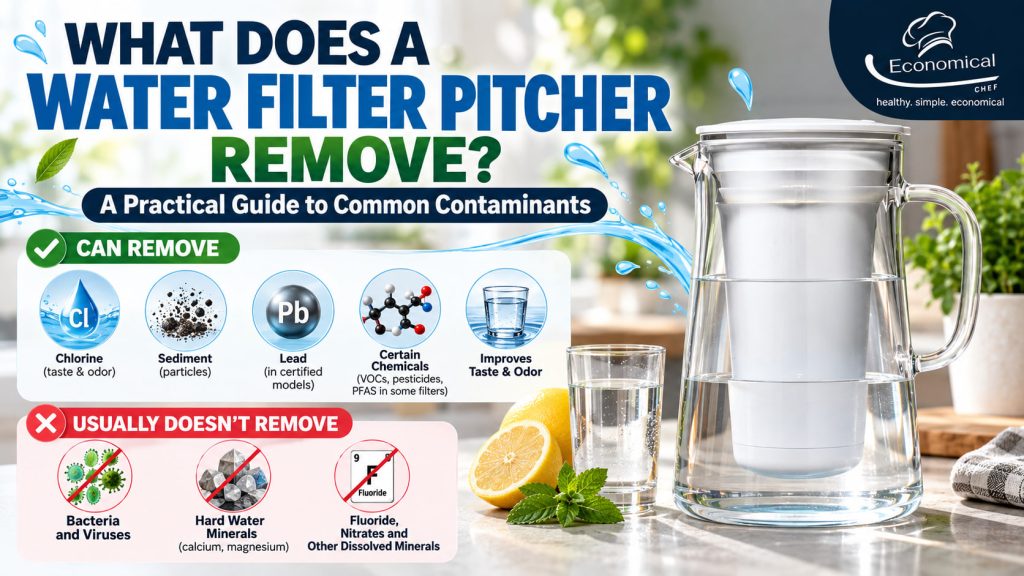
What Can a Water Filter Pitcher Remove?
There isn’t one universal list because different pitchers use different filter designs. The most reliable approach is to check the product’s performance data or certification for specific contaminant-reduction claims.
Here are some of the most common categories.
1. Chlorine
One of the main reasons people use water filter pitchers is to improve the taste and smell of tap water.
Filters certified to NSF/ANSI 42 can be tested for aesthetic contaminants such as chlorine, taste and odor. The U.S. Centers for Disease Control and Prevention (CDC) also notes that activated-carbon and NSF 42 filters can improve the taste and smell of drinking water.
From a chef’s perspective, this can make a noticeable difference when brewing coffee, making tea or drinking water straight from the glass.
2. Sediment and Particles
Some pitcher filters can reduce particulate matter suspended in water.
NSF/ANSI 42 includes particulate-reduction claims, but the exact performance depends on the individual product. The U.S. Environmental Protection Agency (EPA)’s guidance for pitcher filters also distinguishes particulate reduction from other contaminant claims.
If your tap water occasionally looks cloudy or contains small particles, check the filter’s specifications rather than assuming every pitcher will handle them.
3. Lead
Some water filter pitchers are specifically certified to reduce lead.
This is particularly important because lead can enter drinking water through certain plumbing materials, including older service lines and household plumbing components. The U.S. EPA recommends looking for point-of-use or pitcher filters that have been evaluated by an accredited third-party certification body for lead reduction.
However, not every water filter pitcher removes lead.
When lead is a concern, look for a specific lead-reduction claim rather than simply seeing the words “NSF certified.” NSF explains that certification to a standard does not mean a filter reduces every contaminant covered by that standard.
4. Certain Chemical Contaminants
Some advanced pitcher filters are designed to reduce particular chemicals and volatile organic compounds (VOCs).
NSF/ANSI 53 covers numerous health-related contaminant-reduction claims, but the claims vary from one certified product to another. In other words, two pitchers can both carry NSF/ANSI 53 certification while having different contaminant-reduction capabilities.
This is why I recommend checking the specific contaminant listed on the performance data sheet, rather than choosing a pitcher based only on its filtration technology.
5. Some Emerging Contaminants
Certain advanced filters are also tested for emerging contaminants.
NSF/ANSI 401 addresses specific emerging or incidental contaminants, including certain pharmaceuticals, over-the-counter medications, pesticides and other chemical compounds.
Some filters may also have specific certifications for PFAS reduction. NSF notes that filters certified to applicable NSF/ANSI 53 or NSF/ANSI 58 requirements with a PFAS designation can be used for PFAS reduction claims.
Again, this does not mean every water filter pitcher removes PFAS. Look for a specific certification and contaminant claim.
What Does a Water Filter Pitcher Usually Not Remove?
This is where many shoppers get confused.
A standard pitcher filter isn’t a universal water purification system.
Bacteria and Viruses
Most common household pitcher filters are not designed to remove germs. The U.S. Centers for Disease Control & Prevention (CDC) specifically warns that many pitcher and refrigerator filters are primarily intended to improve taste and smell or reduce certain chemicals rather than remove microorganisms.
If microbiological contamination is a concern, you need a treatment system specifically designed and certified for the microorganisms involved.
Hard Water Minerals
Standard carbon pitcher filters aren’t necessarily designed to soften hard water.
Hardness is primarily associated with minerals such as calcium and magnesium. Some specialized filtration systems use ion exchange or other technologies to address hardness, but you shouldn’t assume a conventional carbon pitcher will significantly soften your water.
Fluoride, Nitrates and Other Dissolved Minerals
Whether a pitcher reduces fluoride, nitrate or other dissolved substances depends on the filter technology and its specific certification.
A filter should never be selected based on a generic claim such as “reduces impurities.” Check the manufacturer’s certified performance claims for the exact substance you’re concerned about.
The Most Important Rule: Check the Certification
When shopping for a glass water filter pitcher, don’t stop at phrases such as “advanced filtration” or “multi-stage filter.”
Instead, look for recognized standards and specific contaminant claims.
| Certification | What It Can Indicate |
|---|---|
| NSF/ANSI 42 | Aesthetic contaminants such as chlorine, taste, odor and particulates |
| NSF/ANSI 53 | Specific health-related contaminants, such as lead or certain VOCs |
| NSF/ANSI 401 | Specific emerging or incidental contaminants |
| Other standards | May apply to specialized treatment technologies |
These standards are not rankings of filtration quality. They describe different types of performance claims. NSF Standards for Water Treatment Systems emphasizes that consumers should check both the applicable standard and the specific contaminant the product has been certified to reduce.
How to Choose the Right Water Filter Pitcher
Before buying a pitcher, start with your water rather than the product.
If you’re on a municipal water supply, check your local water quality report to understand what contaminants may be present. NSF also recommends identifying the contaminants in your water before selecting a treatment system.
Then ask:
- What do I want to improve? Taste, odor, chlorine or something more specific?
- Are there contaminants I specifically need to reduce?
- Does the filter have a third-party certification for those contaminants?
- How often does the filter need replacing?
- Is the pitcher practical for my household and refrigerator?
This approach prevents you from paying for filtration features you don’t actually need.
Don’t Forget Filter Maintenance
Even a well-designed filter needs proper maintenance.
Filters can become less effective as they reach their rated capacity, and improperly maintained filters can also become a place where microorganisms grow. The CDC recommends maintaining and replacing pitcher filters according to the manufacturer’s instructions.
For practical maintenance, you can also read our guides on how to clean a glass water filter pitcher properly and how to replace a glass water filter pitcher filter.
These articles are useful companion resources because knowing what a filter removes is only part of owning a pitcher. Keeping the pitcher clean and replacing the cartridge on schedule are equally important.
Final Thoughts
So, what does a water filter pitcher remove? It depends on the specific filter. Many standard pitchers are designed primarily to improve taste and odor by reducing chlorine, while other certified models can reduce particulates, lead, selected VOCs, PFAS or other contaminants.
The key is to avoid treating all water filter pitchers as interchangeable. A filter’s technology, certification and specific contaminant-reduction claims matter far more than a general “multi-stage” or “advanced filtration” label.
If you’re comparing glass models for your kitchen, our Best Glass Water Filter Pitchers guide is the next step. It focuses on the practical considerations that matter when choosing a pitcher, while this article explains what the filtration claims actually mean.
References
- U.S. EPA — Consumer Tool for Pitcher Filters Certified to Reduce Lead — Useful for understanding third-party certification and lead-reduction claims.
- CDC — About Choosing Home Water Filters — Explains what common household filters can and cannot remove.
- NSF — Standards for Water Treatment Systems — Explains NSF/ANSI 42, 53 and other water-treatment standards.
- NSF — Contaminant Reduction Claims Guide — Helpful when matching a filter to a specific contaminant.
- CDC — Preventing Waterborne Germs at Home — Provides guidance on maintaining and replacing household water filters.