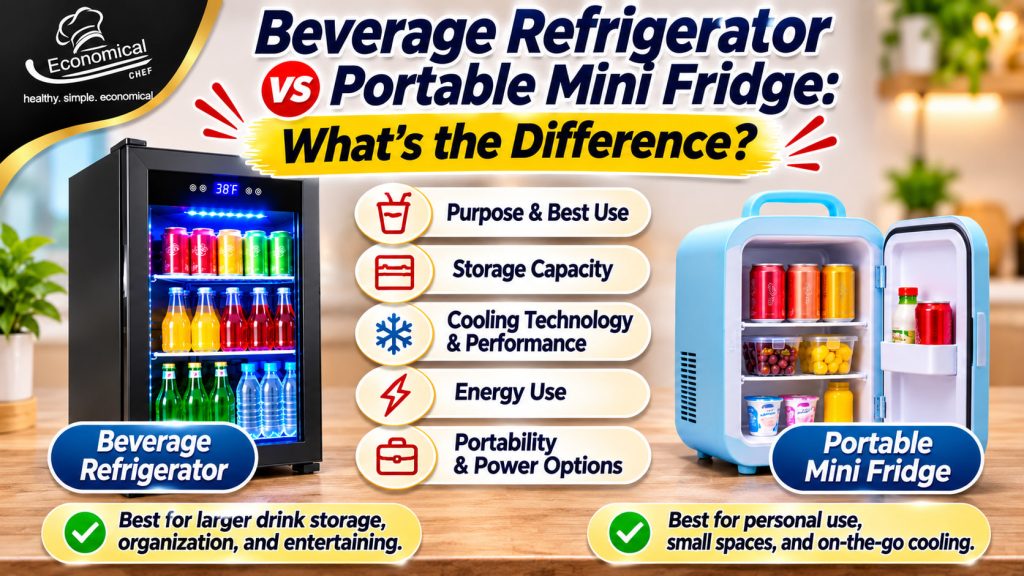
Although these appliances may look similar, their cooling technology, storage capacity, portability, and everyday performance can vary considerably. Understanding these differences will help you choose the right appliance for your needs without paying for features you may not use.
Beverage Refrigerator vs Portable Mini Fridge: Key Differences
| Feature | Beverage Refrigerator | Portable Mini Fridge |
|---|---|---|
| Main purpose | Chilling and organizing drinks | Cooling personal drinks, snacks, and selected small items |
| Storage capacity | Generally larger | Usually compact, often around 4–10 liters for personal models |
| Interior design | Shelves and racks for cans and bottles | Small compartments, removable shelves, or door storage |
| Cooling technology | Often compressor-based; some use thermoelectric systems | Commonly thermoelectric |
| Temperature control | Often adjustable, sometimes with a digital display | Cooling performance often depends on room temperature |
| Portability | Usually designed to stay in one place | Lightweight and easier to carry |
| Power options | Generally standard household electricity | Some models support AC and 12V DC car power |
| Best location | Kitchen, home bar, entertainment area | Bedroom, office, dorm room, or car |
These are general characteristics rather than universal specifications. Always check the manufacturer’s product details because capacity, cooling technology, and power compatibility vary between models.
1. Storage Capacity and Interior Design
A beverage refrigerator is designed to store a larger collection of drinks. Its interior usually features multiple shelves or adjustable racks for soda cans, beer bottles, sparkling water, and other beverages. Many models also have glass doors and interior lighting, making it easy to see your drink selection.
From a chef’s perspective, this organization is particularly useful when entertaining guests. You can arrange beverages by type, keep frequently served drinks accessible, and free up valuable space in your main refrigerator.
A portable mini fridge, on the other hand, is designed for smaller storage needs. Many personal models have capacities of approximately 4–10 liters, although larger options are available. Depending on the design, they may hold several cans, small bottles, skincare products, or packaged snacks.
Some models include removable shelves or door compartments to make better use of the limited interior space. However, they are not designed to store as many beverages as a dedicated beverage refrigerator.
Which is better? Choose a beverage refrigerator if you need organized storage for multiple drinks. A portable mini fridge is more suitable when you only need a small personal cooling space.
2. Cooling Performance and Technology
Cooling technology is one of the most important differences between these appliances.
Many larger beverage refrigerators use compressor-based cooling systems. These systems actively regulate internal temperatures and are generally better suited to maintaining consistent cooling across different room conditions. Some beverage coolers also use thermoelectric technology, so it is important to check the specifications rather than assume every model works the same way.
Portable mini fridges commonly use thermoelectric cooling. Instead of a conventional compressor, they use semiconductor technology to transfer heat away from the interior. These units are generally compact and lightweight, but their cooling performance depends heavily on the surrounding temperature.
For example, a thermoelectric cooler advertised as cooling 20°F below ambient temperature will not necessarily reach the same internal temperature in a hot room as it would in an air-conditioned office.
One important food-safety consideration: the FDA recommends keeping refrigerators at 40°F (4°C) or below. Do not assume a portable mini fridge can safely store dairy products, meat, or cooked leftovers unless you verify that it consistently maintains this temperature with an independent thermometer.
For more information, see the FDA’s Refrigerator Thermometers: Cold Facts about Food Safety.
3. Portability and Power Options
A beverage refrigerator is generally designed to remain in one location. Its larger cabinet, greater storage capacity, and household power requirements make it suitable for kitchens, home bars, offices, and entertainment rooms.
A portable mini fridge is designed with mobility in mind. Many models are lightweight and include carrying handles, making them easier to move between rooms or take on certain road trips.
Some portable models support both standard AC household power and 12V DC vehicle power. This allows you to use them at home or in compatible cars. However, always check the manufacturer’s voltage requirements and vehicle power compatibility before connecting one.
If portability is your priority, a compact personal cooler is usually the more convenient option.
4. Energy Consumption
Neither appliance is automatically more energy-efficient. Electricity consumption depends on capacity, cooling technology, insulation, operating temperature, and how frequently the door is opened.
A larger beverage refrigerator may consume more electricity simply because it has more interior space to cool. However, an efficient compressor model may perform better than a less efficient compact cooler under certain operating conditions.
Portable thermoelectric mini fridges generally have lower power requirements, but their cooling performance can be less consistent in warm environments.
When comparing models, check the manufacturer’s wattage and annual energy consumption, if available. You can also explore our guide on how much electricity a beverage refrigerator uses for a closer look at operating costs.
For additional energy-efficiency guidance, visit ENERGY STAR’s refrigerator information.
Which One Should You Choose?
The best choice depends on how much storage you need and where you plan to use the appliance.
Choose a beverage refrigerator if:
- You regularly store multiple cans and bottles.
- You want organized beverage storage for a home bar or entertainment area.
- You prefer adjustable shelves and easy visibility through a glass door.
- You need a dedicated cooling appliance for drinks.
Choose a portable mini fridge if:
- You only need space for a few drinks or small personal items.
- You want a compact cooler for your bedroom, office, or dorm room.
- You prefer a lightweight appliance that is easy to move.
- You need AC and compatible 12V DC power options for home and vehicle use.
Final Thoughts
When comparing a beverage refrigerator vs portable mini fridge, the biggest difference comes down to storage capacity, cooling performance, and portability. A beverage refrigerator is generally better for keeping a larger selection of drinks organized and chilled in one location. A portable mini fridge is more convenient for personal use when space and mobility matter most.
Before buying, consider the cooling technology, interior capacity, power requirements, and intended use. Most importantly, remember that many small thermoelectric coolers are designed for drinks and personal items rather than dependable long-term storage of perishable food.