Choosing between a compressor and a thermoelectric beverage refrigerator can affect how well your drinks stay chilled, how much noise you hear, and where you can install the appliance. Although both technologies cool beverages, they work differently and perform best under different conditions.
A compressor beverage refrigerator is generally the better choice for larger collections, stronger cooling, and warmer environments. A thermoelectric model is often a good fit for smaller spaces where quiet operation matters and the room temperature is relatively stable. The right choice depends on your storage needs, installation location, and expectations.
What Is a Compressor Beverage Refrigerator?
A compressor beverage refrigerator uses a refrigeration cycle similar to the one found in a conventional kitchen refrigerator. A compressor circulates refrigerant through the system, allowing heat to be removed from the interior and released into the surrounding room.
According to the U.S. Department of Energy’s ENERGY STAR scoping report on residential refrigeration products, vapor-compression systems are one of the main cooling technologies used in refrigerators, including some beverage and wine appliances.
Advantages of compressor models
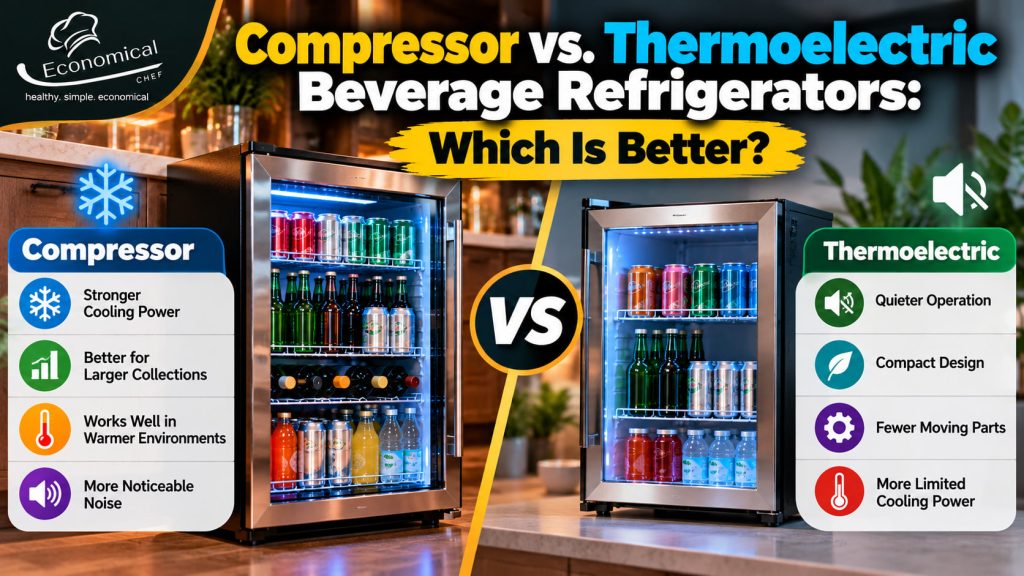
- Stronger cooling capability: Compressor models generally provide more powerful cooling and can reach lower temperatures than comparable thermoelectric units.
- Better for larger collections: They are commonly used in medium and large refrigerators designed to hold many cans and bottles.
- More suitable for varied environments: Depending on the model’s specifications, a compressor unit may perform more reliably than a thermoelectric cooler in a warmer room.
- Good for frequent use: Compressor models are often a practical choice when drinks are added regularly and the refrigerator needs to recover its temperature after the door is opened.
Potential disadvantages
- More noticeable operating noise: Compressor cycling and fan operation can be audible, although noise levels vary considerably by model.
- Possible vibration: Compressors can create vibration, which may matter in quiet rooms or certain wine-storage applications.
- Installation requirements: Proper ventilation and clearance are important for releasing heat and maintaining performance.
From a chef’s perspective, a compressor refrigerator is often the more practical choice for a busy home bar, entertainment area, or kitchen where drinks are accessed throughout the day.
What Is a Thermoelectric Beverage Refrigerator?
A thermoelectric beverage refrigerator uses a solid-state device, often called a Peltier device, to transfer heat from one side of a component to the other when electricity flows through it. Unlike a compressor system, it does not use a conventional compressor-driven refrigerant cycle.
The ENERGY STAR report explains that thermoelectric technology is typically found in smaller refrigeration products such as portable mini fridges and car refrigerators. It also notes that these units generally have more limited cooling capacity than vapor-compression refrigerators.
Advantages of thermoelectric models
- Quiet operation: Without a compressor, these units can operate with less mechanical noise. However, internal fans may still produce sound.
- Low vibration: The absence of a conventional compressor can make them attractive for applications where vibration is undesirable.
- Compact design: Many thermoelectric coolers are designed for desks, bedrooms, small offices, or other spaces with limited room.
- Simple cooling system: Their solid-state design has fewer moving parts in the cooling mechanism itself, although fans and other components can still require maintenance or replacement.
Potential disadvantages
- More limited cooling power: Thermoelectric models may struggle to achieve the same low temperatures as compressor refrigerators.
- Sensitive to room temperature: Their cooling performance depends heavily on the surrounding environment and the temperature difference the unit can maintain.
- Less suitable for hot locations: A warm room can make it difficult for some thermoelectric models to keep beverages sufficiently cold.
- Often smaller capacity: Many are designed for modest drink collections rather than heavy daily use.
A thermoelectric cooler can work well for a small collection of canned drinks in a temperature-controlled office or bedroom. I would be more cautious about choosing one for a hot kitchen or a frequently used entertainment area.
Compressor vs. Thermoelectric: Key Differences
| Feature | Compressor | Thermoelectric |
|---|---|---|
| Cooling power | Generally stronger | More limited |
| Low-temperature performance | Usually better | Depends heavily on room temperature |
| Noise | Compressor and fan noise may be noticeable | Usually quieter, but fans can still make noise |
| Vibration | Possible | Generally lower |
| Warm-room performance | Often better, within its rated operating range | Can be more easily affected by heat |
| Typical applications | Home bars, kitchens, larger drink collections | Small offices, bedrooms, compact drink storage |
| Best reason to choose | Cooling performance and capacity | Quiet operation and compact design |
These are general differences, not guarantees. Always compare the specifications and operating-temperature limits of individual models.
Which Beverage Refrigerator Is Better for Your Needs?
Choose a compressor model if you:
- Store a large number of cans and bottles.
- Want stronger cooling performance.
- Keep the refrigerator in a relatively warm kitchen or entertainment space.
- Open the door frequently during gatherings.
- Need a wider selection of capacities and configurations.
For example, a family that regularly stocks soda, sparkling water, bottled drinks, and beer for weekend gatherings will often benefit from a compressor beverage refrigerator with sufficient capacity and adjustable shelves.
Choose a thermoelectric model if you:
- Need a compact cooler for a small collection of drinks.
- Prioritize quiet operation in a bedroom or office.
- Have a relatively cool, stable indoor environment.
- Do not need especially low temperatures or rapid temperature recovery.
For instance, a small office with a modest selection of canned beverages may be well suited to a thermoelectric cooler, provided its rated cooling performance meets the user’s needs.
If you’re comparing actual models, explore our guide to the best beverage refrigerators for different spaces and storage needs.
Which Type Is More Energy-Efficient?
There is no universal winner. Energy use depends on the cooling technology, appliance size, insulation, ventilation, room temperature, thermostat setting, and frequency of door openings.
A small thermoelectric cooler may consume less electricity than a much larger compressor refrigerator, but that does not automatically make thermoelectric technology more efficient for equivalent storage and cooling requirements.
Compare the manufacturer’s energy-consumption figures when available, and consider the appliance’s capacity alongside its electricity use. Avoid choosing a unit based on technology alone.
What About Food Safety?
If you plan to store perishable foods as well as beverages, verify that the appliance can maintain the required temperature consistently.
The U.S. Food and Drug Administration recommends keeping refrigerators at 40°F (4°C) or below and using an appliance thermometer to check the actual temperature. A beverage refrigerator’s advertised temperature range or digital display should not be treated as proof that it can safely store perishable food under every condition.
Read the manufacturer’s instructions and monitor the interior temperature before using a beverage cooler for food that requires refrigeration.
Final Verdict: Compressor or Thermoelectric?
For most households that want a dedicated beverage refrigerator for a kitchen, home bar, or regular entertaining, I would generally favor a compressor model. Its stronger cooling capability and wider range of available sizes make it a versatile option for everyday use.
A thermoelectric model makes more sense when compact size and quiet operation are the main priorities, the room is not excessively warm, and the cooler’s temperature performance suits the drinks you plan to store.
Before choosing, consider your available space, expected capacity, room temperature, noise tolerance, and the manufacturer’s cooling specifications.
You can also read our Beverage Refrigerator Guide: Everything You Need to Know for more information about temperature settings and routine care.
References
- U.S. Department of Energy — ENERGY STAR Scoping Report on Miscellaneous Residential Refrigeration Products: Explains vapor-compression and thermoelectric cooling technologies and discusses their general performance differences.
- U.S. Food and Drug Administration — Refrigerator Thermometers and Cold Facts About Food Safety: Provides guidance on verifying refrigerator temperatures and safely storing perishable foods.